Table of Contents

- Upgraded High-Efficiency 4 Solar Panels: Equipped with 4 premium solar panels, this solar panel charger charges up to 5 times faster than standard single-panel chargers. It enables direct solar chargi…
- Massive 48000mAh Solar Power Bank: Featuring a high-capacity 48000mAh lithium-polymer battery, this solar charger offers enhanced safety and extended battery life—delivering up to 80% more charging cy…
- Built-in 4 Cable for Multi-Device Compatibility: Designed for multi-device charging, this portable solar battery bank includes 3 ports (2 USB-A outputs, 1 USB-C input/output), 4 built-in charging cabl…
How Long to Charge a 20000mAh Power Bank with Solar?
(Affiliate Disclosure: Some of the links in this article are affiliate links. If you purchase through these links, Gadget Earth may earn a small commission at no extra cost to you. We only recommend sustainable gear, off-grid tech, and resources we rigorously evaluate. As an Amazon Associate, we earn from qualifying purchases.)
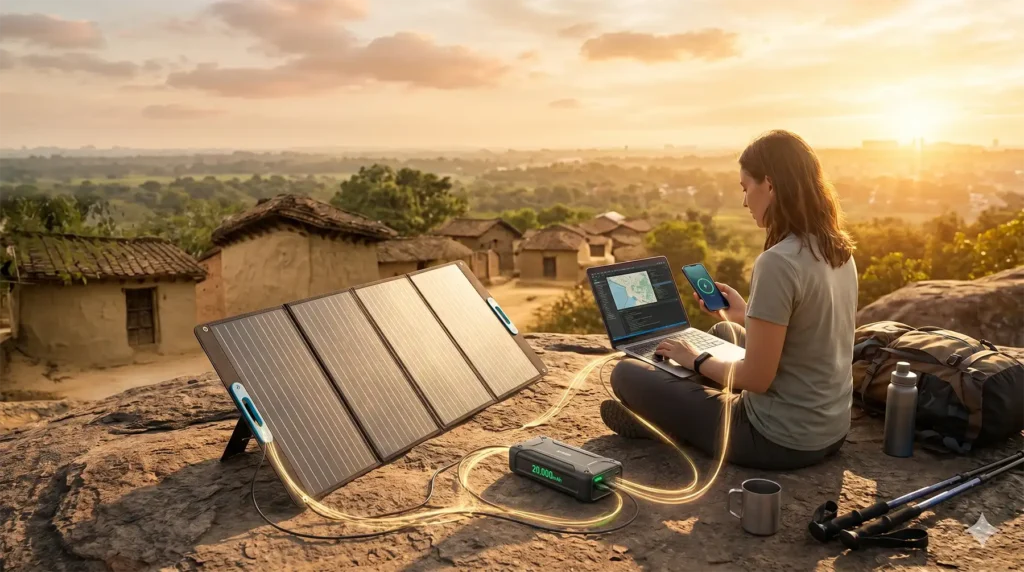
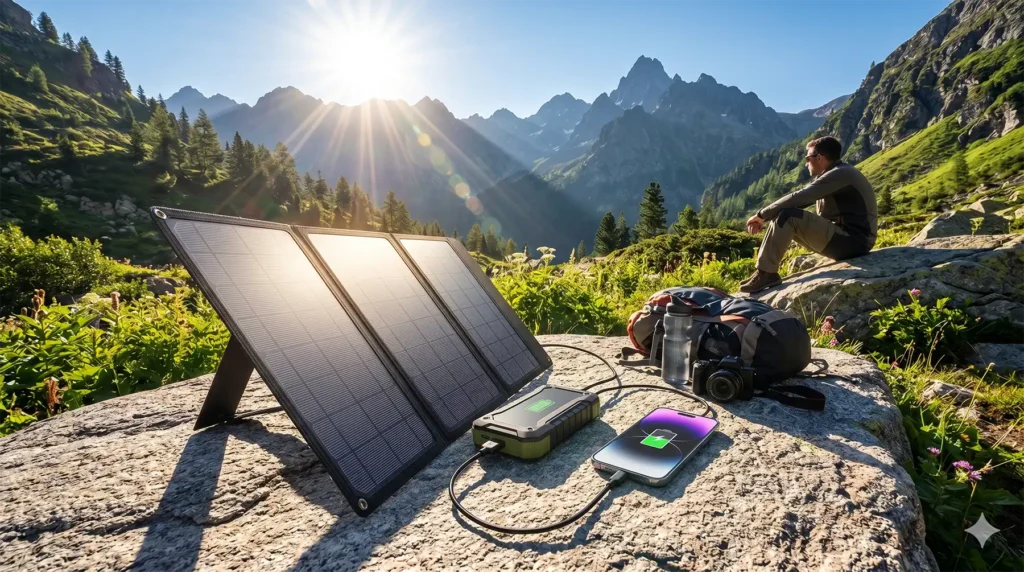
A 20,000mAh portable power bank is the ultimate sweet spot for digital nomads and off-grid travelers. It holds enough juice to charge a smartphone four to five times, or keep a lightweight laptop running through an afternoon of remote work. But when that bank runs dry, plugging it into a solar panel can feel like a guessing game.
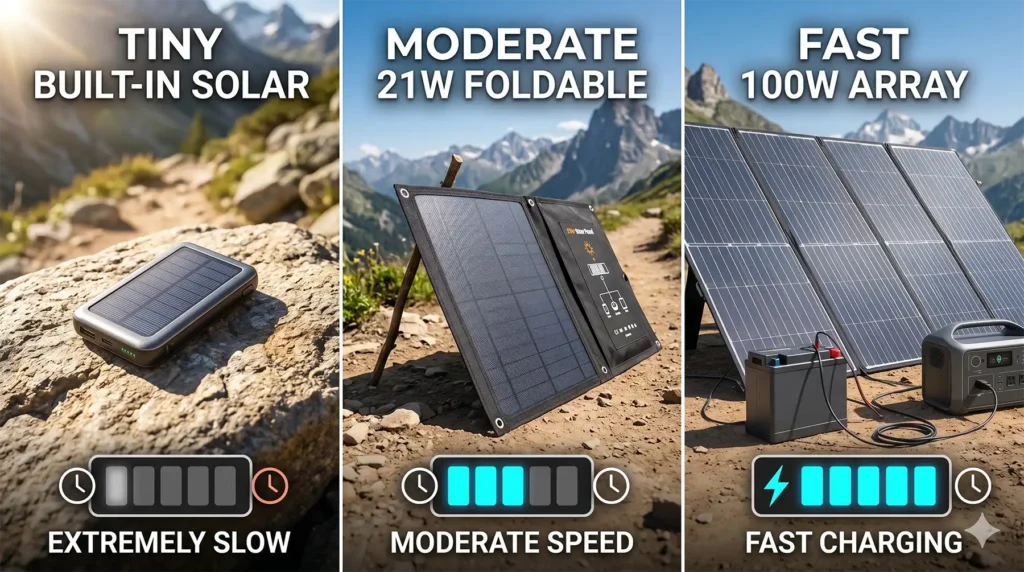
How long to charge a 20000mAh power bank with solar? Using a standard 21W foldable solar panel in direct sunlight, it takes approximately 10 to 12 hours to fully charge a 20,000mAh power bank. If you rely on the tiny built-in solar panels found on some power banks, it will take roughly 70 to 80 hours of direct sunlight.
Why is there such a massive difference? It all comes down to basic electrical math and the physical size of your solar setup. Here is exactly how to calculate your charging time.
Step 1: Converting mAh to Watt-Hours (The Real Math)
To understand charging times, we cannot just look at “mAh” (Milliamp-hours). We have to convert the battery capacity into Watt-hours (Wh), which is the standard measurement of actual energy volume.
Most lithium-ion power banks operate at an internal voltage of 3.7 volts. The formula is: (mAh x Volts) / 1000 = Watt-hours
- (20,000mAh x 3.7V) / 1000 = 74 Watt-hours (Wh)
This means your 20,000mAh power bank holds roughly 74Wh of total energy. To fill it up, your solar panel needs to generate 74 Watts of power over a one-hour period (or 37 Watts over two hours, etc.).
Step 2: How Your Solar Panel Wattage Changes the Timeline
Now that we know we need 74Wh to fill the bank, we divide that by the real-world output of your solar panel. (Remember: Solar panels never hit their advertised peak wattage. A 21W panel usually outputs around 10W to 12W in real-world conditions).
Scenario A: The Built-In Solar Power Bank (1.5W Panel) Many hikers buy 20,000mAh power banks with a small solar panel glued to the front. These panels are tiny and max out at roughly 1 Watt of real-world output.
- The Math: 74Wh / 1W = 74 Hours.
- The Reality: Assuming you get 6 hours of peak sunlight a day, it would take over 12 days to charge your power bank this way.
Scenario B: The 21W Foldable Travel Panel This is the standard setup for backpackers. Attached to the outside of a pack or laid on the ground, a good 21W panel yields about 10W of steady power.
- The Math: 74Wh / 10W = 7.4 Hours.
- The Reality: Because of charging inefficiencies (heat loss, cable resistance), you must add a 20% to 30% buffer. It will take 10 to 12 hours (roughly one and a half to two solid days of clear sun) to reach 100%.
Scenario C: The 100W Basecamp Panel If you are van lifing or setting up a remote work basecamp, you might have a 100W rigid or foldable panel. These output roughly 70W in good sun.
- The Math: 74Wh / 70W = 1.05 Hours.
- The Reality: Accounting for efficiency loss, a 100W panel can blast a 20,000mAh power bank from zero to full in just 1.5 to 2 hours.
3 Factors That Secretly Slow Down Your Charge
Even with perfect math, the outdoors can throw off your charging timeline:
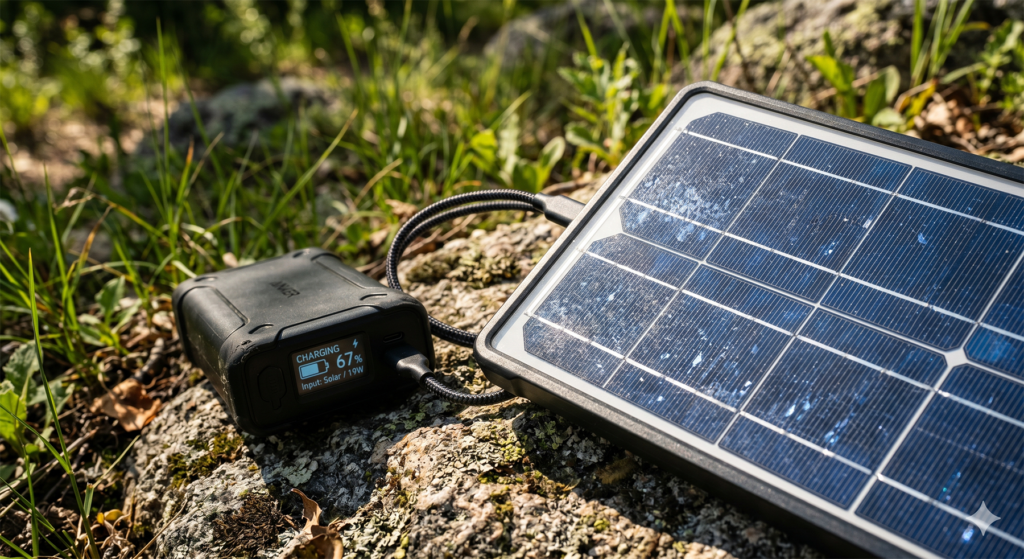
- Extreme Heat: Solar panels work best when they are cool. If your panel is baking on a hot rock in 95°F (35°C) weather, its efficiency drops significantly. Furthermore, if your power bank gets too hot, its internal safety sensors will throttle (slow down) the incoming charge to prevent a battery fire.
- Cloud Cover & Shadows: A single branch casting a shadow across a corner of your solar panel can drop its overall energy output by 30% to 50%.
- Low-Quality Cables: Frayed or cheap USB cables create resistance. Always use a thick, high-quality, braided cable (ideally the one that came with your power bank or solar panel) to ensure maximum energy transfer.

- Massive Power Anywhere: This 192Wh battery delivers 200W and includes one 140W two-way USB-C fast charging ports.
- 5 Device Charging Ports: Power all your tech with versatile ports, including 1× USB-C (100W), 1× USB-C (140W), 1× USB-C (15W), and 2× USB-A (12W).
- Travel-Friendly Design: 39% smaller than similar power stations, attach the strap (sold separately) to easily carry your power.
- Upgraded High-Efficiency 4 Solar Panels: Equipped with 4 premium solar panels, this solar panel charger charges up to 5 times faster than standard single-panel chargers. It enables direct solar chargi…
- Massive 48000mAh Solar Power Bank: Featuring a high-capacity 48000mAh lithium-polymer battery, this solar charger offers enhanced safety and extended battery life—delivering up to 80% more charging cy…
- Built-in 4 Cable for Multi-Device Compatibility: Designed for multi-device charging, this portable solar battery bank includes 3 ports (2 USB-A outputs, 1 USB-C input/output), 4 built-in charging cabl…
The Gadget Earth Verdict
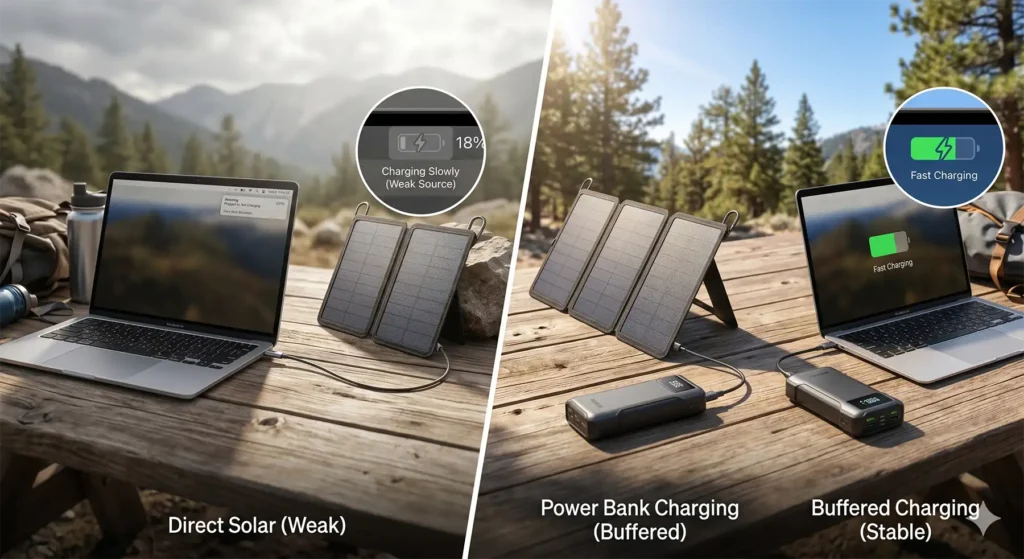
If you are carrying a 20,000mAh power bank off-grid, a 21W foldable solar charger is the absolute minimum you should pair it with. Expect to leave it in the sun for about a day and a half to get a full charge. Better yet, embrace the “top-up” method: plug your power bank into your solar panel every single morning, replacing the energy you used the night before, rather than waiting for the bank to hit 0% before you start charging.