Table of Contents
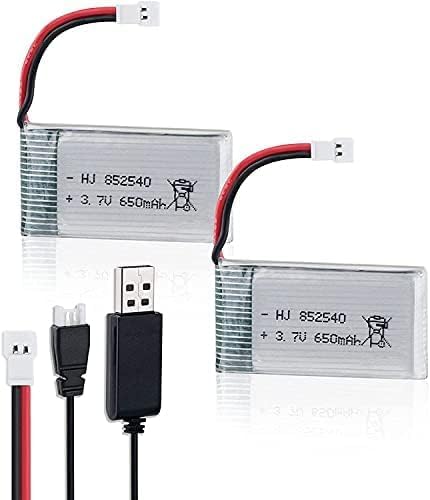
- Specifications: XH2.54 Connector, Voltage 3.7V, capacity 650mAh, battery size 44 * 25 * 9mm/1.73 * 0.98 * 0.35 inches, weight :17.6g. Make sure your Drone or other RC toy’s battery is compatible with …
- USB charging cable: The 3.7V Lipo battery comes with a charging cable that you can charge with a power bank, a car power source, or a computer. The charger cable works with most, but not all, 3.7v bat…
- More capacity: This 650mAh rechargeable lithium battery allows you to enjoy longer flight time, and the built-in protection IC makes your device safer
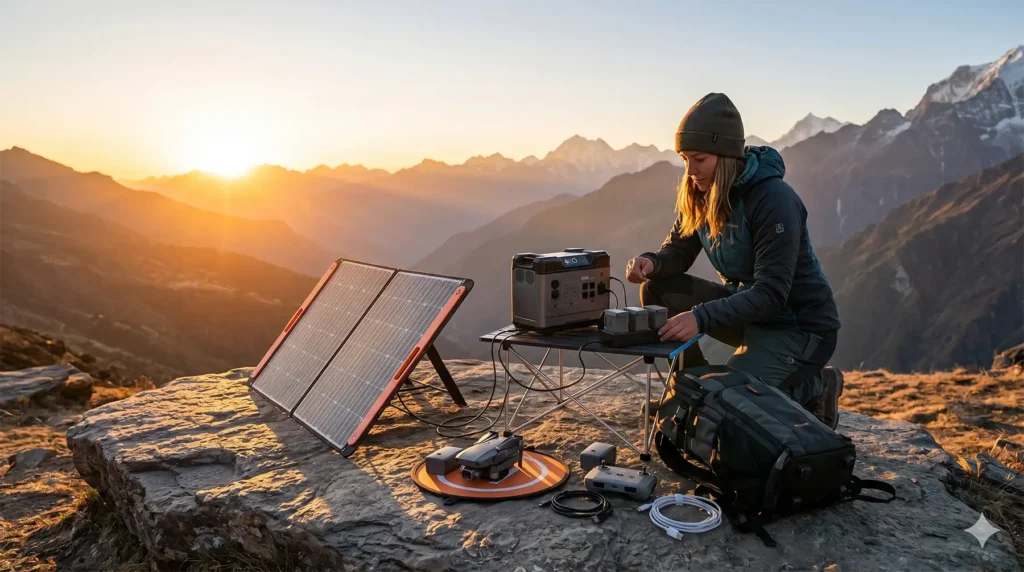
How to Charge Drone Batteries Off Grid
Capturing cinematic aerial footage of a remote mountain peak or an isolated beach is incredibly rewarding. However, drone batteries are notorious power hogs. A standard flight time of 25 to 40 minutes means your batteries will be dead long before you are ready to pack up camp.
How do you charge drone batteries off grid? The safest and most efficient method is using a portable power station (like a Jackery or EcoFlow) paired with a 100W solar panel. For smaller, travel-friendly drones, a high-capacity 65W Power Delivery (PD) power bank offers a lightweight, backpack-friendly charging alternative.
Because drone batteries use volatile Lithium Polymer (LiPo) chemistry, you cannot just plug them into a cheap solar panel and hope for the best. Here is the step-by-step guide to safely charging your drone anywhere on earth.
The Power Math: Why Drones Are Hard to Charge
Unlike a smartphone that trickle-charges easily, drones require serious wattage.
If you fly a professional rig like a DJI Mavic 3, the charging hub requires at least 65W to 100W of continuous power to charge efficiently. Even smaller, sub-250g drones like the DJI Mini 4 Pro require around 30W.
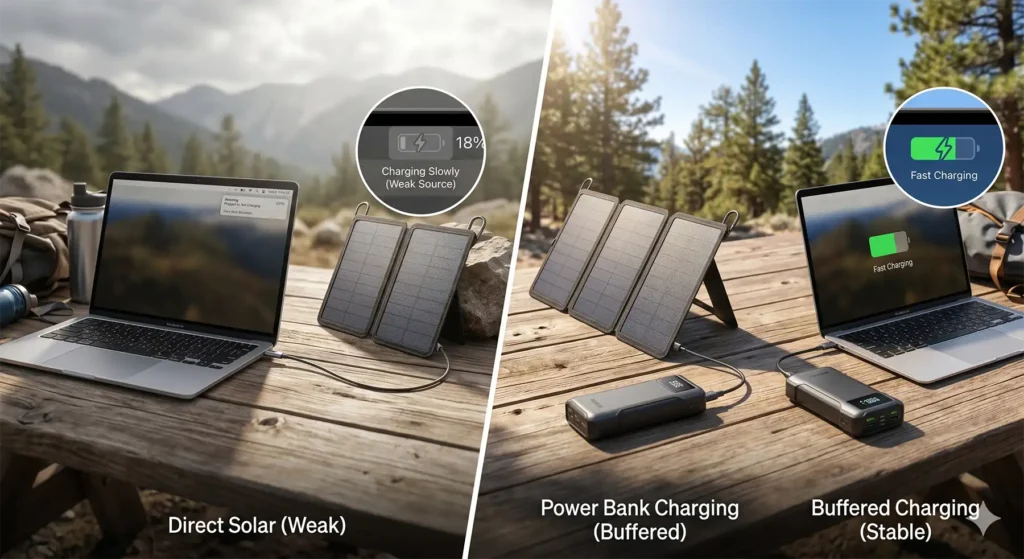
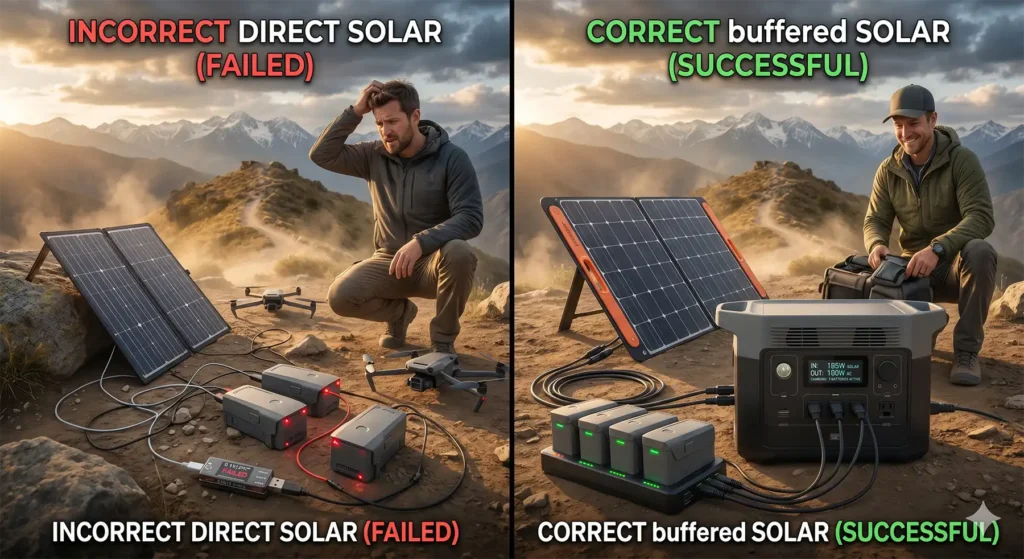
If you try to plug a drone charging hub directly into a low-wattage 21W foldable solar panel, the hub will likely reject the charge entirely, or it will take an entire day to charge a single battery. You need a “middleman” power reservoir.

- Perfect for Solar Generators: Plug & play. The SOLUPUP bifacial solar panel features a 5-in-1 multi-function connector (XT60, DC5521, DC7909, DC8020, and Anderson) and is designed to work seamlessly w…
- Bifacial Technology: Unlike standard solar panels that only capture sunlight from the front, our bifacial design absorbs reflected light from the back side as well. This means that under the same ligh…
- Power Upgrade: Need more juice? Connect two 100W solar panels in series or parallel using a Y-cable (sold separately) to double the output. Ideal for larger power stations, faster emergency backup, or…
Method 1: The USB-C PD Power Bank (Best for Micro Drones)
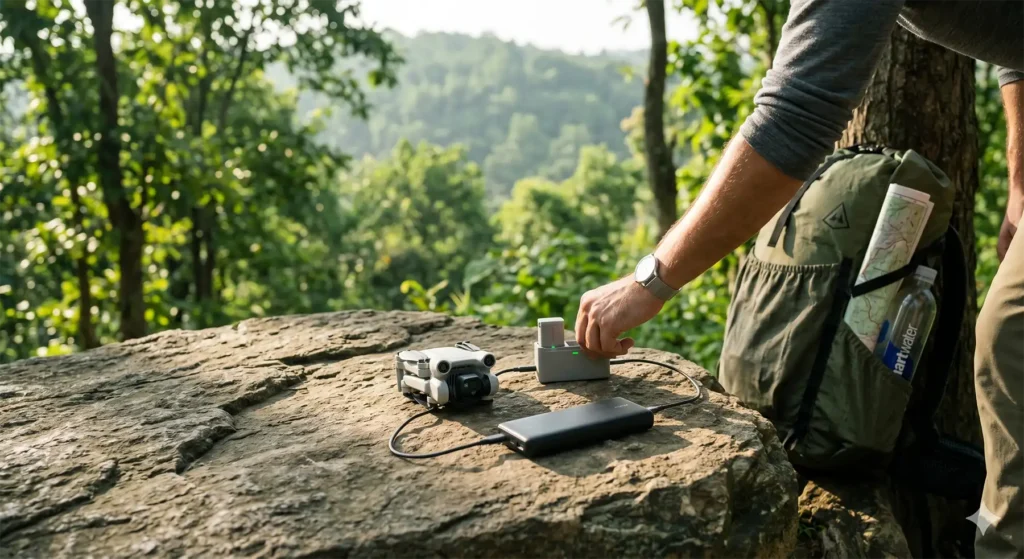
If you are a backpacker flying a lightweight micro-drone and need to keep your pack weight down, this is your best option.
- Get the Right Bank: Purchase a 20,000mAh to 26,800mAh portable power bank. Crucially, it must feature a USB-C Power Delivery (PD) output of at least 45W (ideally 65W+).
- Direct USB-C Charging: Modern micro-drones allow you to plug a USB-C cable directly into the drone body or a multi-battery charging hub.
- The Yield: A 20,000mAh bank can typically recharge a small drone battery (like the DJI Mini series) about 3 to 4 times before the power bank itself is depleted.

- 🔋Double the Capacity, JUST 35% HEAVIER: With twice the capacity of standard power banks, this 20,000mAh portable charger with built-in cords powers an iPhone 16 up to 3 times, Galaxy S24 up to 2.9 tim…
- Built-in 4 Cables: Includes 3 output cables and 1 input cable, letting you charge almost all devices—iPhone, iPad, Galaxy, other USB-C phones, tablets, and Micro devices—without carrying extra cords o…
- Charge 6 Devices at Once: This portable chargers for multiple devices features 6 outputs (3 built-in cables + 3 external ports) and 4 inputs (2 built-in cables + 2 external ports), allowing you to cha…
Method 2: The Portable Power Station (Best for Pro Drones & Van Life)
If you are driving to your location, living in a van, or operating a larger drone like a Mavic or Inspire, you need a basecamp power station.
- Size Your Station: A 300Wh to 500Wh power station (like an EcoFlow River 2 or Jackery Explorer 300) is the sweet spot.
- Use the AC Outlet or High-Speed USB-C: Power stations feature standard 120V wall outlets, allowing you to plug in your drone’s factory wall charger exactly as you would at home.
- The Yield: A 300Wh station can charge a high-capacity professional drone battery 4 to 6 times.

- SPEED UP YOUR RECHARGEABILITY: It takes only 2 hours to recharge 80% battery of the power station through the wall outlet and 60W PD USB-C port simultaneously. You can also recharge your power station…
- SAFE & STEADY POWER SUPPLY: Armed with a 293Wh lithium-ion battery pack, the Explorer 300 features 2 Pure Sine Wave AC outlets that deliver stable and safe 300W power. The portable power station weigh…
- POWER YOUR EXPECTATIONS: Featuring 2* AC outlet, 1* PD 60W USB-C port (input/output supported) , 1* fast charge 3.0 port, 1*USB-A port and 1* DC car port, the power station is camping essential that c…

- Portable Power Station With 256Wh LiFePO4 Battery – Dyness 300W portable power station provides reliable backup power for home, camping, and outdoor use. Built with LiFePO4 battery technology for long…
Method 3: The 12V Car Charger Hack (Maximum Efficiency)
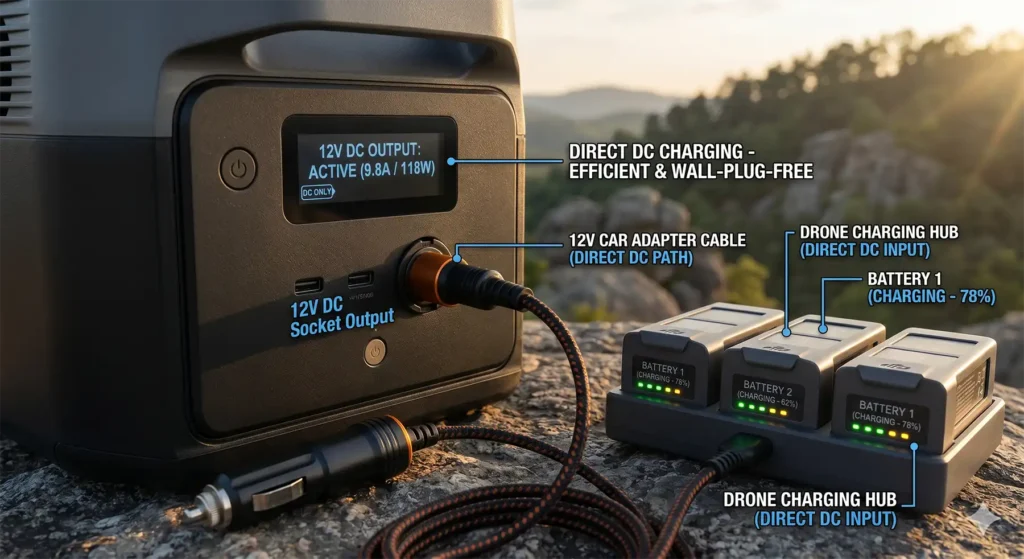
If you are using a portable power station, here is a secret efficiency hack: stop using the AC wall outlet.
When you use the AC wall outlet on a power station, the station’s internal inverter has to convert DC battery power into AC power, and then your drone’s charging brick converts it back to DC. This double-conversion process wastes up to 20% of your energy as heat.
The Fix: Buy the official 12V car charger accessory for your drone. Plug it directly into the 12V “cigarette lighter” port on your portable power station. This keeps the power in DC format the entire time, saving your battery life and giving you an extra charge or two out of your station!

- Triple-Port 167.5W Max: Seamlessly power up all your essential devices with the first USB-C port delivering a powerful 100W, the second USB-C port providing 45W, and the USB-A port adding an additiona…
- Ultra-Fast 100W USB-C1 Port: With the first USB-C port offering 100W, quickly charge your 16-inch MacBook Pro from 0 to 50% in only 47 minutes.
- Reliable 45W USB-C2 Port: The second USB-C port offers 45W max of power, providing fast and reliable charging for iPhones and Samsung devices, keeping you connected without any delays.
Recharging Your Setup with Solar
Once your power bank or power station is depleted, you need the sun to reset the cycle.
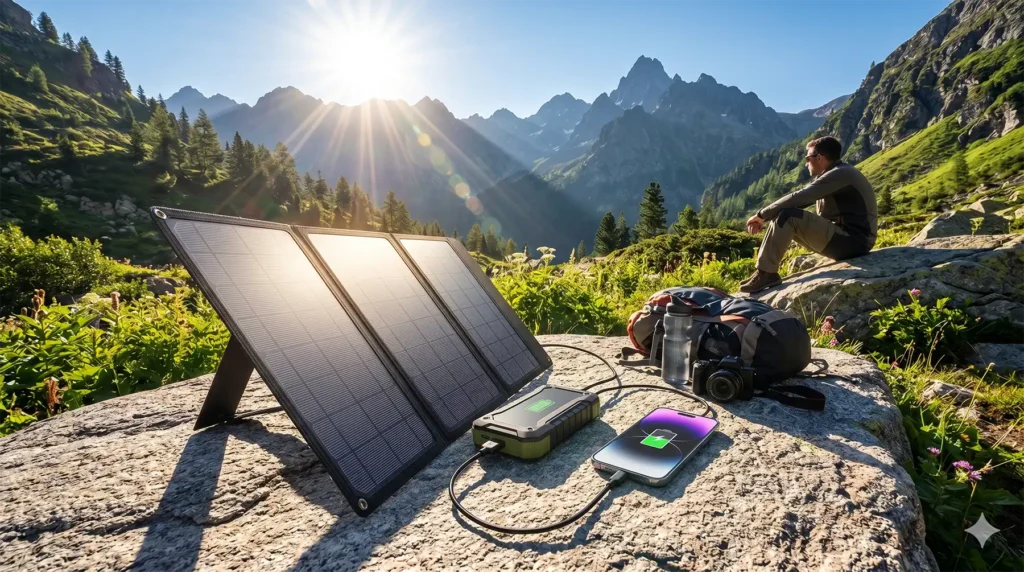
- For Power Banks: A 21W or 28W folding solar panel is sufficient to slowly recharge a 20,000mAh bank over a day or two.
- For Power Stations: You will need a rigid or foldable 100W solar panel. Under clear skies, a 100W panel can fully recharge a 300Wh power station in about 4 to 5 hours, giving you a completely sustainable, infinite drone charging loop.

- 【23.5% High-Efffciency A+ Monocrystalline Cells】Constructed with premium Grade A+ silicon cells, this 100W solar panel outperforms conventional polycrystalline panels, delivering higher conversion rat…
- 【True 5-in-1 Universal Connectivity】 Unlike standard 4-in-1 cables, our upgraded solar cable features 5 distinct connectors to fit 99% of power stations: 1. DC8020 (Speciffcally for Jackery Explorer 1…
- 【IP67 Waterproof ETFE Coating】 Designed for the unpredictability of outdoor life. The advanced ETFE lamination offers superior durability, heat resistance, and light transmittance compared to PET pane…
Crucial Off-Grid Charging Safety Rules
- Never charge a hot battery: If you just landed your drone, the battery is hot. Let it cool in the shade for 15 minutes before plugging it in. Charging a hot LiPo battery degrades its lifespan and creates a severe fire risk.
- Keep power stations in the shade: While your solar panel needs to be in direct sunlight, ensure your portable power station or power bank is tucked behind the panel or under a tree.
By building a reliable “middleman” system with the right power bank or station, you can keep your drone in the air day after day without ever seeing a wall outlet.