Eco-Tech Carbon Offset Estimator
Grid power or a pocket of sunlight?
Every charge has a source. See what a year of charging your phone, laptop, and camera off portable solar actually saves — in kilograms, miles, and trees.
Carbon intensity varies a lot by country — this sets your "before solar" baseline.
How many days a year is this trip, shoot, or off-grid stint?
How many of each device are you keeping alive, per day?
~15 Wh / day each
~60 Wh / day each
~20 Wh / day each
Your Yearly Impact
0 kg
of CO2e saved per year
Charging on the grid for 180 days would have cost 0 kg of CO2e. A portable solar setup takes that to zero.
0 mi
of gas-car driving avoided
0 🌱
tree seedlings grown 10 yrs
Share Your Setup
Estimates use published average grid carbon intensities and typical device charging draw. For illustration, not a certified carbon audit.
Grid Power or a Pocket of Sunlight? What Charging Your Gear Actually Costs the Planet
I’ll admit something: for years, I never thought twice about where the electricity charging my phone actually came from. I’d plug in at a coffee shop, a hotel, an airport lounge — wherever — and move on with my day. It wasn’t until I started tracking gear for longer trips that I realized how much that habit adds up over a year.
That question is exactly what pushed me to build a free tool for this: the Eco-Tech Carbon Offset Estimator. It’s a simple calculator that compares charging your everyday devices off the standard power grid versus a portable solar setup, and shows you the real difference over 365 days. I want to walk you through why that difference matters more than most people assume, and how to think about it without getting lost in jargon.
The Grid Isn’t the Same Everywhere
Here’s the part that surprised me most when I started digging into this: “the grid” isn’t one thing. Carbon intensity — basically, how much CO2e gets released per kilowatt-hour of electricity — swings wildly depending on where you are and what’s feeding that country’s power plants.
A country leaning heavily on coal is going to produce a lot more emissions per charge than one running mostly on hydro or nuclear. That’s not an opinion; it’s just how the fuel mix works. (For exact, up-to-date figures by country, I’d point you to sources like the IEA or your national energy agency rather than trust a random blog number — those figures shift year to year.)
What this means practically: if you’re an outdoor hobbyist, a digital nomad, or someone who just travels a lot with a laptop and a camera, your carbon footprint from charging depends heavily on your location, not just your gear.
Small Devices, Surprisingly Big Numbers
None of this feels like it should matter much on a device-by-device basis. A phone charge is what, an afternoon’s worth of energy? True. But that’s the trap — we tend to judge environmental impact by how something feels in the moment, not by what it looks like multiplied across a year.
Here’s a rough way to picture typical daily charging draw:
- Smartphones — a light load, charged daily
- Laptops and tablets — a noticeably heavier draw, especially if you’re working off one all day
- Cameras and drones — smaller than a laptop, but easy to forget you’re charging two or three batteries a day on a shoot
Multiply any one of those by 180 or 300 days of active use in a year, and the number stops looking small. That’s really the whole point of the estimator — it turns an invisible, gradual habit into one clear annual figure.
Why Portable Solar Actually Changes the Math
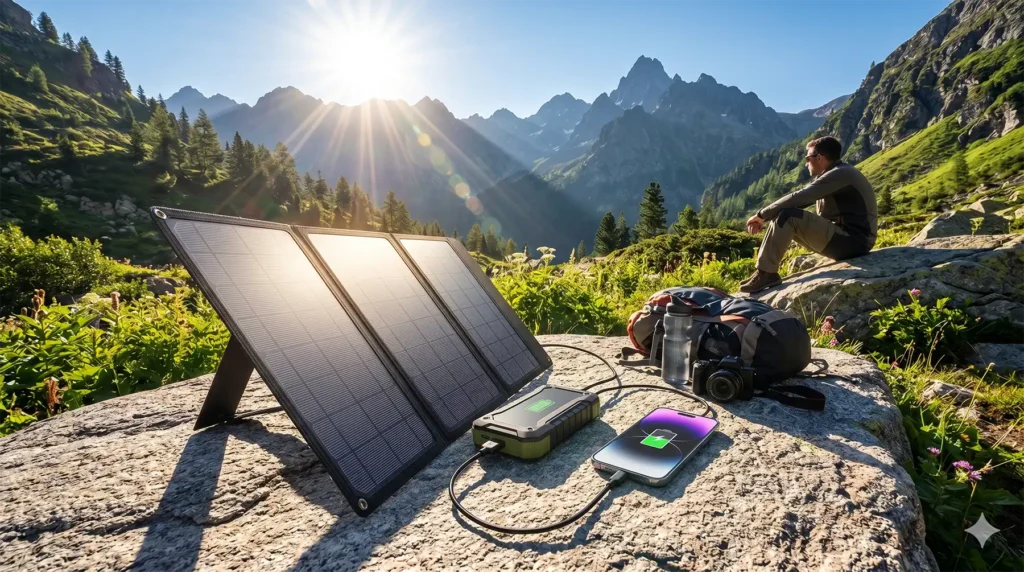
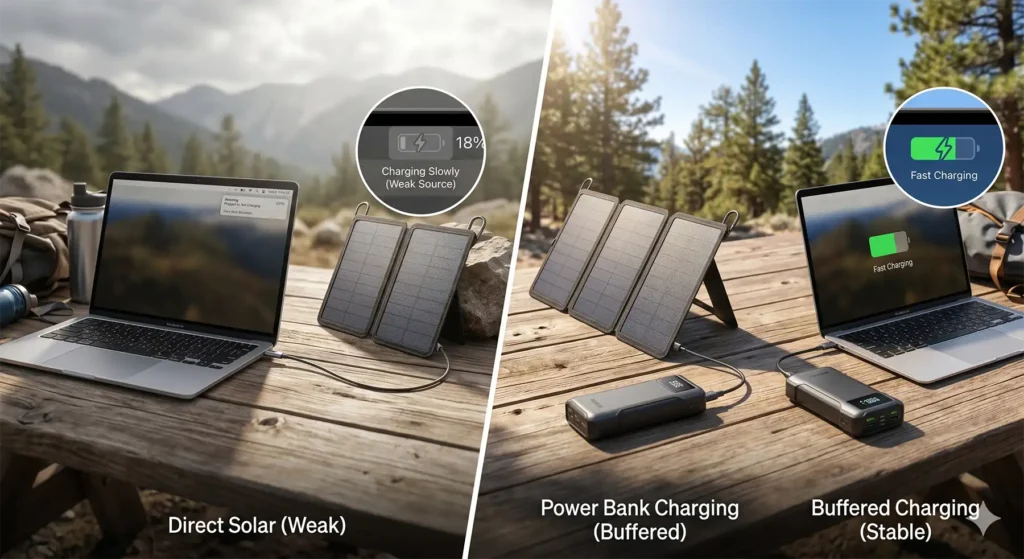
I want to be careful here, because “solar panel” can sound like a marketing buzzword rather than something with a measurable effect. The honest version is this: a portable solar setup converts sunlight directly into the electricity your devices use, without pulling from a grid that’s burning fuel somewhere upstream. For the days you’re genuinely charging off solar instead of a wall outlet, the emissions tied to that charging session are effectively zero.
That doesn’t mean solar is free of any footprint at all — manufacturing a panel has its own environmental cost, and I’d rather say that plainly than pretend otherwise. But once you own the panel, every subsequent charge you take off it, instead of off the grid, is a real offset. Over months of travel or fieldwork, that adds up to something worth paying attention to.
Grid vs. Solar, Side by Side
| Charging on the Grid | Charging on Portable Solar | |
|---|---|---|
| Emissions per charge | Varies by region’s fuel mix | Effectively zero during use |
| Upfront cost | None (already paying for power) | One-time panel purchase |
| Best for | Occasional, short-term use | Frequent travel, off-grid days |
| Reliability | Consistent, weather-independent | Depends on sunlight access |
Neither option is “wrong.” If you’re charging a phone twice a month while traveling, the grid impact is genuinely minor. But if you’re spending a third of your year off-grid — camping, shooting, working remotely — the gap starts to look meaningful.
Quick gut check: If you added up every day you charged a device away from home last year, would that number be closer to 20 days or 200? The estimator is built around that exact question, because the answer changes everything about whether solar is worth it for you.
How I’d Actually Use This Tool
I didn’t build this as an abstract exercise — I built it because I wanted a fast way to answer a specific question: is it worth carrying a solar panel on this next trip?
Here’s how I’d suggest using it:
- Pick your region, since that sets your grid baseline.
- Enter how many phones, laptops, and cameras you’re realistically charging in a day.
- Slide to the number of days you’re actually off-grid or traveling.
- Look at the yearly CO2e figure — and the driving-miles and tree-seedling comparisons, which make the number easier to feel rather than just read.
That last part matters to me. A kilogram of CO2e doesn’t mean much on its own. Translating it into “equivalent to X miles not driven” gives it a shape you can actually reason about.
The Bigger Picture
I don’t think one calculator changes the world, and I’m not going to pretend it does. But small, honest tools like this are how I’ve come to think about sustainable tech in general — not as one dramatic swap, but as a series of smaller, informed decisions that compound over a year of travel, work, and everyday charging.
If you’re curious where you land, give the estimator a try. And if the numbers make a solar setup look worthwhile for how you actually travel, that’s exactly the kind of gear we focus on here at Gadget Earth.
Note for editorial review: all grid carbon-intensity and conversion figures referenced here should be verified against current IEA, EPA, or equivalent national energy agency data before publishing, since these figures are updated periodically.