Table Of Contents

- CLINICALLY OPTIMIZED HEIGHT ADJUSTMENT – REDUCES RAINOUT & IMPROVES THERAPY PERFORMANCE: Precisely positioning your CPAP or BiPAP machine at the correct height relative to your bed is one of the most …
- UNIVERSAL COMPATIBILITY – WORKS WITH MOST CPAP AND BIPAP MACHINES: My CPAP Caddy is designed to accommodate most major CPAP and BiPAP machine brands and models right out of the box, including Philips …
- MOBILE WHEN YOU NEED IT, STABLE WHEN YOU DON’T – INDEPENDENT LOCKING CASTER WHEELS: My CPAP Caddy features four heavy-duty locking caster wheels that allow you to roll your machine effortlessly to you…
How to Run a CPAP Machine Off Grid Camping
(Affiliate Disclosure: Some of the links in this article are affiliate links. If you purchase through these links, Gadget Earth may earn a small commission at no extra cost to you. We only recommend sustainable gear, off-grid tech, and resources we rigorously evaluate. As an Amazon Associate, we earn from qualifying purchases.)
Having sleep apnea should never stop you from exploring the backcountry or sleeping under the stars in a remote van. However, CPAP (Continuous Positive Airway Pressure) machines are notoriously power-hungry. If you simply plug your machine into a small battery pack like you would at home, it will be completely dead by 2:00 AM.
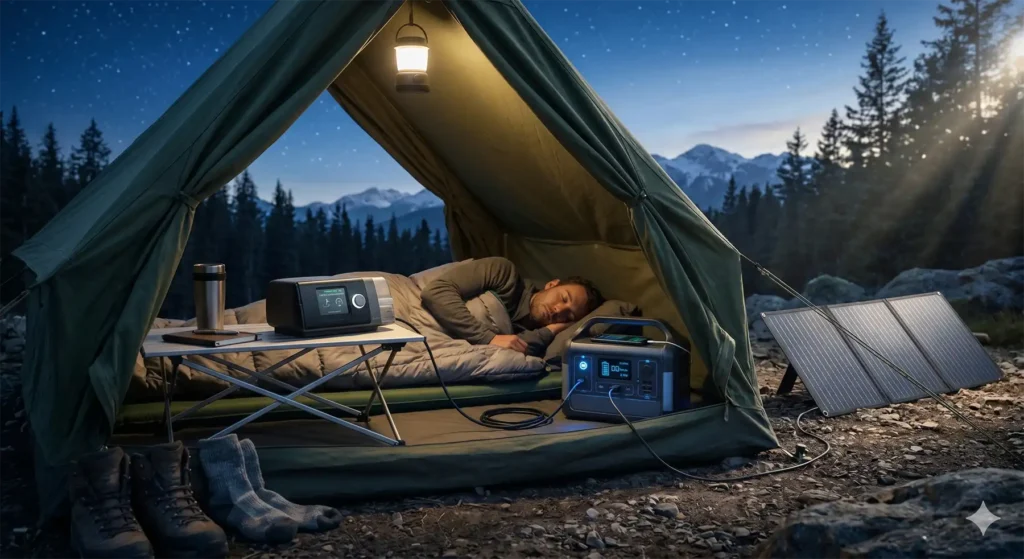
How do you run a CPAP machine off grid camping? The most reliable way to run a CPAP off-grid is to power it using a 300Wh to 500Wh portable power station paired with a dedicated 12V DC power cable. To guarantee the battery lasts all night, you must physically turn off your CPAP’s heated humidifier and heated tubing.
With the right setup, you can easily power your CPAP machine for multiple nights in the wilderness. Here is the exact mathematical breakdown and the gear you need to sleep safely off the grid.
The Golden Rule: Turn Off the Heat
This is the single most important secret to off-grid CPAP camping.
Standard CPAP machines (like the popular ResMed AirSense 10 or 11) have three main functions: blowing air, heating the water in the humidifier chamber, and heating the actual breathing tube to prevent condensation.
- With Heat ON: The machine can draw 90 to 100 Watts of power continuously. A standard 300Wh power station will die in just 3 hours.
- With Heat OFF: The machine only uses the fan motor to push air. The power draw drops plummet to an incredibly low 10 to 15 Watts. A 300Wh power station will now last for 3 to 4 full nights (roughly 24 hours of total run time).
Before you leave for your trip, go into your CPAP’s clinical settings and disable both the heated tube and the humidifier. If you live in a dry climate and absolutely need humidity, leave water in the chamber so the air blows over it passively, but ensure the electronic heating plate is turned off.
The Gadget Earth Hack: Use a 12V DC Cable
When off-grid beginners buy a portable power station, their first instinct is to plug their standard CPAP wall plug directly into the AC wall outlet on the front of the station. Do not do this.
When you use the AC outlet, your power station’s internal inverter has to convert its DC battery power into AC power. Then, your CPAP’s power brick converts it back to DC power. This double-conversion wastes up to 20% of your precious battery capacity as pure heat.
The Solution: Buy a dedicated 12V DC Car Adapter Cable specifically made for your CPAP model (ResMed and Philips both sell official versions, and Amazon has certified third-party options). Plug this directly into the 12V “cigarette lighter” port on your power station. This keeps the power in a highly efficient DC format the entire time, saving you massive amounts of energy.

- Powerful yet Compact: Boasting a 1,500W AC output and a 3,000W surge peak, the Solar Generator 1000 V2 can power multiple appliances, including AC units, fridges, and electric pots. With a 1,070Wh cap…
- One Hour Fast Charging: Charge your Explorer 1000 v2 Portable Power Station from 0% to 100% battery level in just one hour with emergency charging activated via the Jackery App. It defaults to 1.7 hou…
- 10 Year Lifespan: The Explorer 1000 v2 portable power station is equipped with a durable LFP battery, maintaining over 70% of its original capacity even after 4,000 charge cycles, offering longevity e…
Choosing the Right Portable Power Station
You do not need a massive, heavy generator to run a CPAP if you follow the rules above. You want a lightweight power station with a LiFePO4 (Lithium Iron Phosphate) battery for maximum safety and lifespan.
1. The Weekend Warrior: EcoFlow River 2 (256Wh)
If you are only going camping for one or two nights, a 250Wh capacity station is perfect. Weighing under 8 lbs, it is easy to carry to a tent site. With the heat turned off and a 12V cable, the River 2 will easily power a CPAP for two full 8-hour nights before needing a recharge.
2. The Basecamp / Van Life: Jackery Explorer 500 (518Wh)
If you are Boondocking in an RV or setting up a basecamp for a long weekend, upgrade to the 500Wh tier. This provides enough juice to run your CPAP for up to 5 nights, with plenty of leftover energy to charge your smartphone and headlamps during the day.

- FSA/HSA Eligible CPAP Battery with 4 Cables – Compatible with ResMed S9, AirSense 10/11, AirCurve 10/11, AirMini, Philips DreamStation 1/2, and Luna G3(Heated tube not supported).
- Multi-Night CPAP Power – 297.6Wh high-capacity battery supports 2+ nights of CPAP use (without humidifier/heated tube; runtime varies by settings). Note: Exceeds 160Wh TSA limit, not TSA-approved for …
- Wide CPAP Compatibility – Works with most CPAP systems including Sefam S.Box, Resvent iBreeze, Apex iCH, Löwenstein Prisma series, F&P SleepStyle, Breas Z1/Z2, and Transcend series (a DC adapter or ci…
Recharging Your CPAP Setup with Solar
If you are staying off-grid indefinitely, you need a way to recharge your power station each morning.
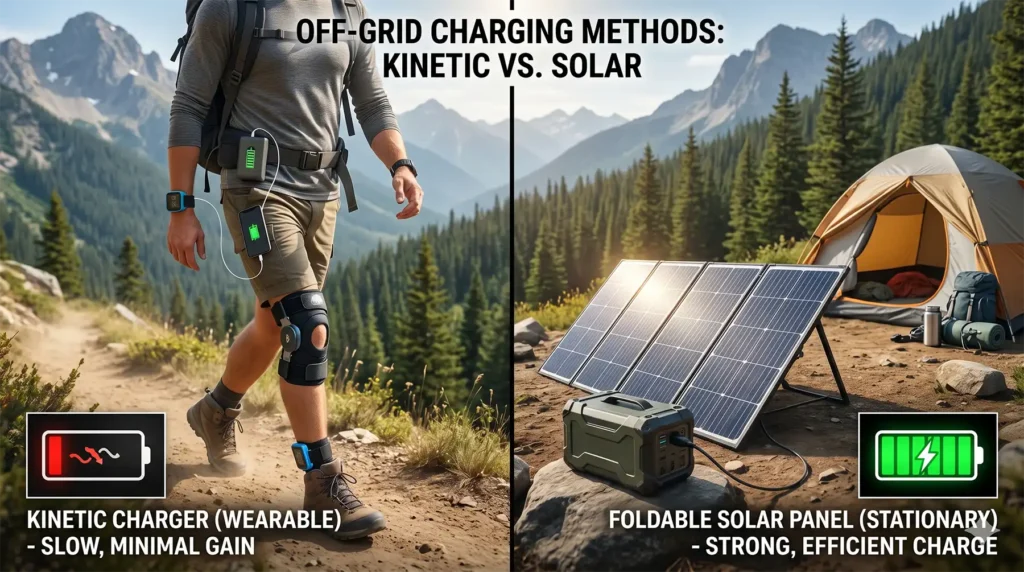
Because CPAP machines are a critical medical device, we recommend over-sizing your solar setup to account for cloudy days. Pair your power station with a 100W Foldable Solar Panel.
When you wake up, set the panel in the sun and plug it into your power station. A 100W panel will generate roughly 60W to 70W of real-world power, meaning it can replace an entire night’s worth of CPAP energy drain in just two or three hours of morning sunlight.
By utilizing 12V DC power, disabling your heaters, and harnessing a reliable solar cycle, you can enjoy perfectly safe, uninterrupted sleep no matter how far off the grid you travel.