Table Of Contents

- SUPER THIN. STRINKINGLY LIGHT. SHOCKINGLY STRONG.—The thinnest iPhone ever, with the power of a pro chip inside. At 5.6 mm, iPhone Air is so impossibly thin and light that it nearly disappears in your…
- MORE DURABLE THAN ANY PREVIOUS iPHONE—Ultralight titanium frame. Ceramic Shield protects the back of iPhone Air, making it 4x more resistant to cracks. And the new Ceramic Shield 2 on the front has 3x…
- TWO ADVANCED CAMERAS IN ONE—48MP Fusion camera system with 2x optical-quality zoom. Effortlessly frame the perfect shot from right where you are.

- UNIBODY DESIGN. FOR EXCEPTIONAL POWER.—Heat-forged aluminum unibody design for the most powerful iPhone ever made.
- DURABLE CERAMIC SHIELD. FRONT AND BACK.—Ceramic Shield protects the back of iPhone 17 Pro Max, making it 4x more resistant to cracks. And the new Ceramic Shield 2 on the front has 3x better scratch re…
- THE ULTIMATE PRO CAMERA SYSTEM—With all 48MP rear cameras and 8x optical-quality zoom—the widest zoom range ever in an iPhone. It’s the equivalent of 8 pro lenses in your pocket.
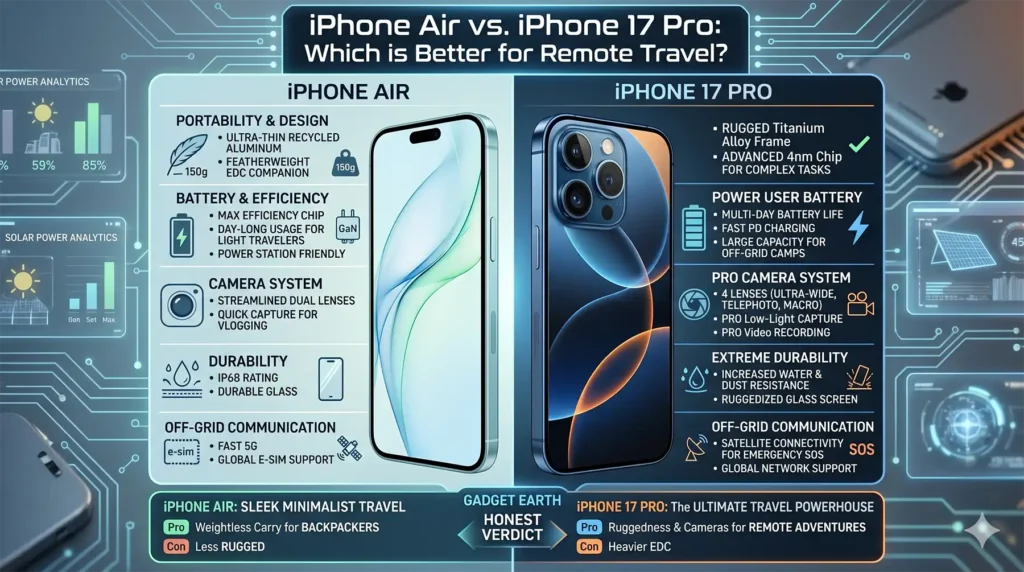
iPhone Air vs. iPhone 17 Pro: Which One is Right for You?
Affiliate Disclosure: Some of the links in this article are affiliate links. If you purchase through these links, Gadget Earth may earn a small commission at no extra cost to you. We only recommend sustainable gear, off-grid tech, and resources we rigorously evaluate. As an Amazon Associate, we earn from qualifying purchases.
Every September, the tech world obsesses over the newest Apple releases, comparing screen bezels and camera sensors. But when you are a digital nomad working from a remote cabin or a backpacker calculating every ounce of gear, standard tech reviews miss the point entirely. You don’t just need a fast phone; you need a device that balances durability, battery life, and off-grid charging efficiency.
In 2026, Apple split its premium lineup, forcing a massive decision for travelers: the ultra-thin iPhone Air or the rugged, feature-heavy iPhone 17 Pro.
If you are trying to optimize your travel kit, here is the ultimate off-grid comparison between the iPhone Air and the iPhone 17 Pro.
The Ultralight Contender: iPhone Air
The iPhone Air represents a massive design shift, prioritizing an unbelievably thin chassis and shedding the weight of previous generations.
Why it works for travel:
- Ultralight Pack Weight: If you are a minimalist hiker who counts every gram in your bag, the Air is the ultimate communication device. It practically disappears in a pocket or a running belt.
- Low-Capacity Charging: Because the physical chassis is so thin, the internal battery is smaller. While this means less overall screen time, it also means your 10,000mAh solar power bank will be able to charge the iPhone Air from 0 to 100% more times than it could charge a Pro model.
The Off-Grid Downside:
- Thermal Throttling: Thin metal gets hot under the sun. If you are using GPS mapping apps in 95°F weather, the iPhone Air has less thermal mass to dissipate heat. It will likely dim its screen and throttle charging speeds much faster than a thicker phone to prevent battery damage.
The Basecamp Powerhouse: iPhone 17 Pro
The Pro lineup remains the heavy-duty tool for remote professionals and content creators who need maximum performance regardless of the environment.
Why it works for travel:
- Titanium Durability: The Grade-5 titanium frame is incredibly drop-resistant. If your phone takes a tumble off a rock while you are setting up a solar panel, the Pro is significantly more likely to survive without a shattered chassis compared to the ultra-thin Air.
- Maximum Battery Endurance: The thicker frame houses a substantially larger battery. If you are caught in a storm and your solar panels are useless for two days, the iPhone 17 Pro will hold onto its charge significantly longer when left in low-power or airplane mode.
- The Satellite Lifeline: While both models feature Emergency SOS via satellite, the Pro’s larger battery gives you more time to maintain a crucial connection during a grid-down emergency.
The Off-Grid Downside:
- Power Hunger: The Pro’s massive battery and 120Hz display require serious wattage to recharge. If you are relying on a small 21W foldable solar panel, it is going to take significantly longer to bring the iPhone 17 Pro back to 100% than the iPhone Air.
Off-Grid Charging Math: Which is Easier to Power?
When you are away from wall outlets, you have to treat your phone battery like a water canteen. How much energy does it take to fill it up?
Let’s assume you are carrying our top-recommended off-grid power setup: a rugged 10,000mAh Power Bank (roughly 37 Watt-hours of energy).
- Charging the iPhone Air: Because of the smaller internal battery, a 10,000mAh power bank can comfortably recharge the iPhone Air roughly 2.5 to 3 times. If you use your phone sparingly for just navigation and reading, that single power bank can keep you off the grid for almost a week.
- Charging the iPhone 17 Pro: The massive battery inside the Pro model requires more energy. That same 10,000mAh power bank will only yield about 1.5 to 1.8 full charges. You will be tethered to your solar panels much more frequently to keep your “middleman” power bank topped up.

- Dimensions: 7.5″ x 4.3″ x 2.2″. Compact size and lightweight make it easy to carry and put into your backpack, handbags or laptop bag without taking much space. Suitable for family use and daily organ…
- Quality Material: This electronic organizer travel case made of high quality durable waterproof oxford and soft sponge inside to secure your gadgets in place and deliver a quick access whenever you wa…
- Double Layers Design: This tech pouch features a double-layer interior design with 8 compartments, including multiple see-through mesh pockets and ample space to store your cords, cables, USB drives, …

- [Innovative Lens-Inspired Design & Bluetooth 5.2] The ATUMTEK Bluetooth Camera Remote features a unique camera lens-inspired aesthetic, enhancing its appeal. Equipped with the latest Bluetooth 5.2 tec…
- [Universal Compatibility & No App Required] This remote is universally compatible with iOS 7.0 and Android 5.0 or higher devices, providing a seamless experience with various smartphones and tablets. …
- [Extended Battery Life for Prolific Shooting] Powered by an upgraded CR2032 button battery, our remote supports the capture of up to 20,000 images, making it perfect for vacations, weddings, and exten…

The Gadget Earth Verdict
Choose the iPhone Air if: You are an ultralight backpacker or a minimalist traveler. If your phone spends 90% of its time in your pocket or airplane mode, and you prioritize shedding physical weight above all else, the Air is a brilliant piece of engineering that demands less energy from your portable solar setup.
Choose the iPhone 17 Pro if: You are a remote professional, van-lifer, or content creator. The titanium durability, superior thermal management in hot climates, and massive internal battery make it the most reliable tool for harsh, off-grid environments. Just ensure you pack a high-capacity (20,000mAh+) power bank to keep it fed.