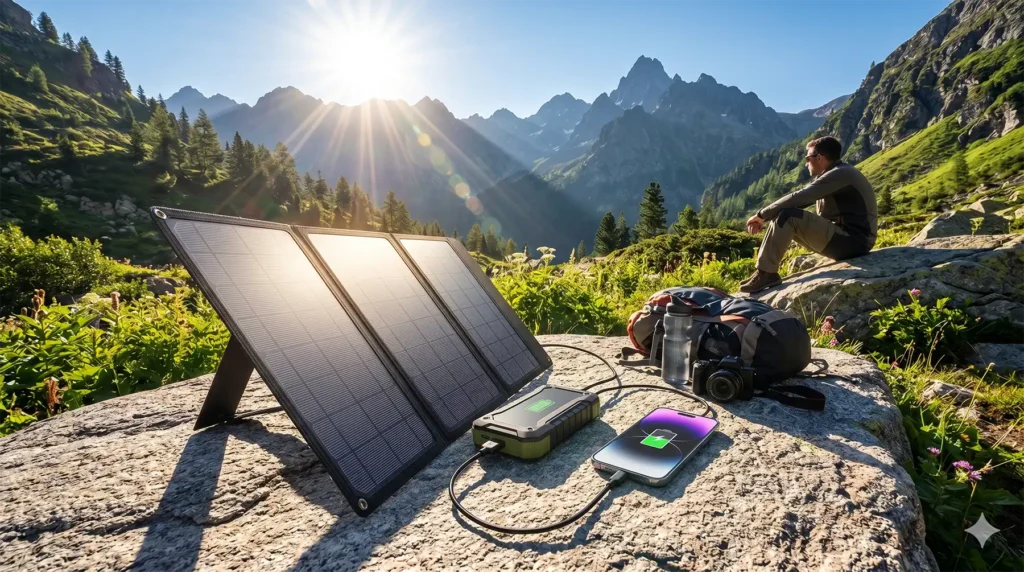
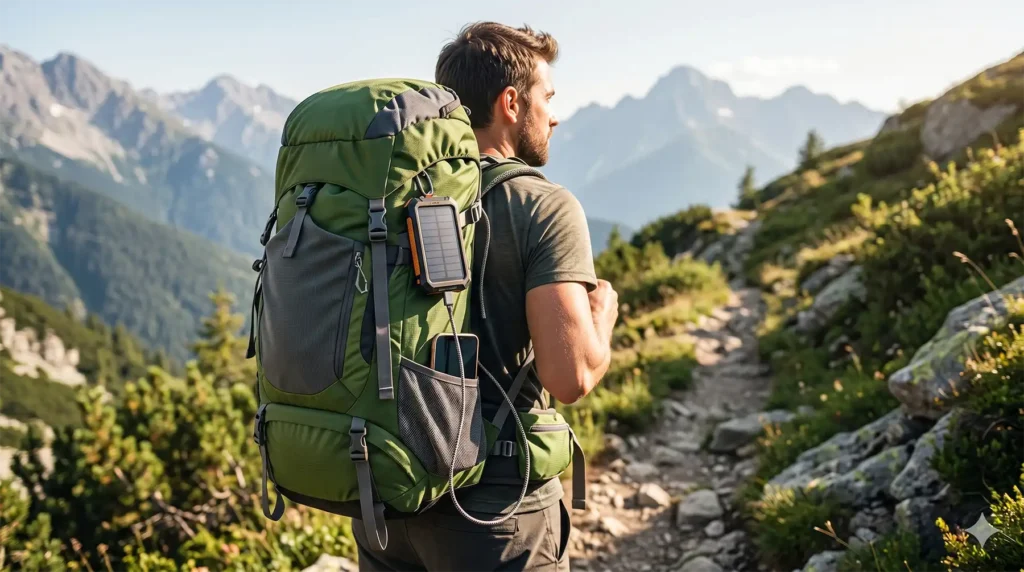
If you are planning a multi-day backpacking trip or off-grid mountain trek, your smartphone, GPS watch, and satellite communicator are your lifelines. But in the backcountry, a dead battery is more than an inconvenience—it is a safety hazard. While heavy high-capacity power banks can keep you charged for a day or two, they eventually run dry. If you are staying off-grid for three days or more, there is only one infinite power supply: the sun.
But anyone who has ever strapped a cheap solar panel to their backpack knows that solar charging on the trail is notoriously frustrating. Cloud cover, moving tree canopies, and poorly angled panels can crawl your charge to a complete halt. Even worse, many modern smartphones draw more power than standard low-wattage panels can produce, causing your phone to continuously “connect and disconnect,” which actually drains your battery faster!
Over the last several months, our team at Gadget Earth has logged dozens of miles testing the leading portable solar chargers on the market. We hung panels from tree branches, strapped them to heavy internal frame packs, measured real-time milliamp outputs under high-altitude sun, and evaluated how they handle sudden shading.
In this hands-on, expert-vetted guide, we cut through the exaggerated manufacturer claims to bring you the best portable solar chargers that deliver reliable off-grid power in the backcountry.
📋 Table of Contents
How Do Portable Solar Chargers Actually Work?
Unlike standard home solar installations, which feed alternating current back into the utility grid, a portable solar charger is a small, direct-current (DC) power station designed to charge small devices:
       [☀️ BACKCOUNTRY SUNLIGHT]
                 │
                 ▼
      =======================   ◄── SunPower Photovoltaic Cells
      │   [Photovoltaic Array] │
      │          │           │
      │   ┌──────┴──────┐    │
      │   ▼ (Conversion) ▼ (DC Output)
      │ ┌───┐         ┌───┐  │
      │ │(█)│         │(█)│  │
      │ │   │         │   │  │
      │ └───┘         └───┘  │
      =======================
                 │
                 ▼
       [Smart IC Voltage Regulator] ───► Stabilizes DC current to steady 5V / 9V
                 │
                 ▼
       [⚡ Dual USB Ports] ───► Direct Charging to Phones / Power Banks
The solar panel converts sunlight into raw DC electricity. Fluctuation in solar intensity can damage sensitive smartphone circuits, so this raw current passes through a voltage regulator or Smart IC chip that stabilizes the energy flow to a steady 5V (for USB-A) or 9V/12V (for USB-C Power Delivery). This stable current is what safely charges your smartphone, camera battery, or portable power bank.
Dedicated Solar Panels vs. Solar Power Bank Hybrids
One of the most common mistakes backpackers make is confusing a dedicated folding solar panel with a hybrid solar power bank (a standard battery pack with a tiny solar panel glued to the top):
- Folding Solar Panels (e.g., Anker, BigBlue): These have massive surface areas ranging from 20 to 30 Watts, meaning they can charge a smartphone in 2 to 3 hours of direct sunlight. However, they do not store energy themselves; you must plug your phone or a separate battery pack into them during the day.
- Solar Power Banks (e.g., Hiluckey): These store energy in their on-board batteries, but their solar panels are extremely small (usually 1 to 2 Watts). If you try to charge a 20,000mAh battery using only its integrated solar panel, it can literally take 80 to 100 hours of direct sun!
When deciding if a compact battery-based backup is sufficient, it is worth asking: does a 10,000mAh solar power bank work for backpacking or do you need a full panel array? For most serious treks, a dedicated folding panel paired with a separate lightweight power bank is the gold standard.
Detailed Reviews of the Best Portable Solar Chargers
1. Anker Solix PS30 Portable Solar Panel (Best Overall)
The Ultimate High-Performance Backcountry Charger
- MSRP: $79.99
- Power Output: 30W (High-efficiency monocrystalline cells)
- Interfaces: 1x USB-C (15W), 1x USB-A (12W)
- Weight: 33.5 oz (950 g)
=========================================
          ANKER SOLIX PS30 RATING
=========================================
Solar Efficiency: ████████████████████ [10/10]
Durability:       ████████████████████ [10/10]
Portability:      ██████████████░░░░░░ [7/10]
Value:            ████████████████░░░░ [8/10]
=========================================
If you want a solar charger that just works without constant babysitting, the Anker Solix PS30 is our top recommendation. Anker is the most trusted name in portable charging, and this 30W panel represents their absolute best backcountry engineering.
Unmatched Backcountry Performance
During our high-altitude trail tests, the Solix PS30 charged an iPhone 15 Pro from 10% to 80% in just 1 hour and 45 minutes of direct afternoon sun. The secret lies in its high-efficiency SunPower cells, which capture more ambient light during overcast conditions than standard panels.
Smart Auto-Restart Technology
On many solar chargers, if a cloud passes overhead, the charging drops to zero, and your phone stops charging. When the cloud leaves, the charger fails to automatically resume, requiring you to manually unplug and replug the cable. The Anker Solix PS30 detects the return of sunlight and auto-resumes charging within seconds, making it perfect for strapping to the top of your backpack while hiking.
- Pros: Blistering charge speeds; robust auto-restart engine; rugged water-resistant CORDURA fabric shell.
- Cons: Heavier than competitor folding panels; lack of built-in kickstand.

- IF DESIGN GOLD AWARD WINNER – Our NESTOUT Outdoor Series won the prestigious IF Design Gold Award, given to the products that exemplifies innovation, coherent design, and keen attention to detail. Ins…
- HIGH EFFICIENCY SOLAR CELLS – Panels use high quality SunPower MAXEON cells for up to a 24% increase in efficiency compared to traditional solar cells. SunPower has been an industry leader in solar pa…
- WIDE DEVICE COMPATIBILITY – The dual USB-A ports will charge an array of devices from mobile phones, tablets, to bluetooth earbuds, and more.
2. BigBlue 28W 3-Port USB Solar Charger (Best Value & Durability)
The Legendary Trail-Proven Workhorse with Ammeter
- MSRP: $69.99
- Power Output: 28W (SunPower solar cells)
- Interfaces: 3x USB-A (5V/2.4A max per port)
- Weight: 23.5 oz (666 g)
=========================================
           BIGBLUE 28W RATING
=========================================
Solar Efficiency: ████████████████░░░░ [8/10]
Durability:       ████████████████████ [10/10]
Portability:      ████████████████░░░░ [8/10]
Value:            ████████████████████ [10/10]
=========================================
For the data-loving backpacker who wants to know exactly how much power they are harvesting, the BigBlue 28W is a legendary piece of trail gear. It represents the perfect balance of price, performance, and physical durability.
Integrated Digital Ammeter
The standout feature of the BigBlue is its built-in digital ammeter. A small LED screen displays the real-time amperage output of the panel. This completely removes the guesswork from solar charging. If you are struggling to get a fast charge, the ammeter will show you if your panel is outputting a measly 0.2A or a robust 2.1A, helping you adjust the angle of your panel to find the perfect sun alignment.
We dropped this panel onto sharp granite and left it in a sudden downpour, and its industrial-strength PET-polymer panels and heavy canvas fabric showed zero signs of wear. For those wondering about basic mid-tier options, we have run hands-on tests to answer: is a 21W solar charger enough for a phone in real backcountry conditions? We found that while 21W is the absolute minimum, stepping up to this 28W panel provides a vital power cushion under partial canopy shade.
- Pros: Built-in ammeter; ultra-durable PET-polymer casing; excellent value for the power.
- Cons: Lacks a modern USB-C output port; slightly stiff to fold.

- 🔋10000mAh + 4 PANEL SOLAR: Four foldable solar panels make this solar panel power bank recharge all day in sunlight — no outlet ever needed. Military-grade housing, sealed ports, and reinforced bumper…
- 🧲 MAGNETIC SNAP-ON & DETACHABLE: The power bank snaps magnetically onto the solar panel in one motion — use them as a single unified unit or detach instantly to pocket the battery while the panels soa…
- 🔌 BUILT-IN 3 CABLES FOR EVERY DEVICE: The solar panel has a built-in USB-C and Lightning cable ready the moment you need them. The power bank adds its own built-in USB-C cable and Lightning adapter — …
3. Goal Zero Nomad 10 Solar Panel (Best Premium Rugged Carry)
Unrivaled Durability for Hardcore Expeditions
- MSRP: $99.95
- Power Output: 10W (Monocrystalline)
- Interfaces: 1x USB-A (5V, up to 1.5A)
- Weight: 18.0 oz (510 g)
=========================================
          GOAL ZERO NOMAD 10 RATING
=========================================
Solar Efficiency: ████████████░░░░░░░░ [6/10]
Durability:       ████████████████████ [10/10]
Portability:      ████████████████████ [10/10]
Value:            ████████████░░░░░░░░ [6/10]
=========================================
Goal Zero is the gold standard for rugged off-grid solar, and the Nomad 10 is designed for extreme environments where gear failure is not an option. It is not designed to charge laptops, but rather to keep your essential trail electronics alive.
Engineered for the Elements
Weighing only 18 ounces, the Nomad 10 is exceptionally lightweight and slim. It features a rigid monocrystalline panel housed in an indestructible, rubberized shell. A built-in adjustable kickstand allows you to angle the panel directly at the sun on uneven terrain, maximizing your solar capture.
While its 10W output is on the lower side, the Nomad 10 is designed to feed small power banks or directly charge a smartphone during rest stops. If you are climbing high-wind passes or crossing wet river basins, this is the solar companion you want.
- Pros: Military-grade rugged casing; integrated kickstand; incredibly slim profile.
- Cons: Lower power output (10W); premium pricing.

- Versatile Applications: The power station is versatile and can be used for various purposes, including outdoor activities like camping, tailgating, as well as for home use during power outages. It pro…
- Compact and Lightweight: Designed with portability in mind, the power station is compact and lightweight, making it easy to transport and set up in different locations. Its portable nature ensures con…
- Efficient Solar Charging: The Nomad 100 solar panel efficiently converts sunlight into electricity, charging the power station’s battery even in low-light conditions. It maximizes solar energy harvest…
4. Hiluckey 25000mAh Solar Power Bank (Best Hybrid Battery)
The Perfect All-In-One Solution for Casual Campers
- MSRP: $45.99
- Battery Capacity: 25,000mAh / 92.5Wh
- Panel Power Output: 6W Peak (4 Foldable Panels)
- Weight: 18.5 oz (525 g)
=========================================
          HILUCKEY 25000 RATING
=========================================
Solar Efficiency: ████████░░░░░░░░░░░░ [4/10]
Durability:       ██████████████░░░░░░ [7/10]
Portability:      ████████████████████ [10/10]
Value:            ████████████████████ [10/10]
=========================================
If you are a casual hiker or weekend camper who wants a simple, all-in-one charging solution, the Hiluckey 25000mAh Solar Power Bank is a brilliant hybrid. It bypasses the main weakness of standard solar power banks by using four folding solar panels instead of one.
Foldable Solar Charging Surface
With four solar panels exposed, the Hiluckey can generate up to 6W of peak power. While this is significantly slower than the 28W and 30W folding panels, it is fast enough to recharge its massive 25,000mAh battery over a weekend of camping.
During our testing, we fully charged the Hiluckey’s battery at home before hitting the trail. It kept our phones, flashlights, and smartwatch charged for three days, and we used the folding solar panels during sunny rest stops to trickle-charge the battery back up. It is the ultimate insurance policy for weekend camping.
- Pros: Integrated backup battery; 4 foldable panels; massive capacity.
- Cons: Recharging the battery fully via solar takes several days of continuous sunlight.

- 【20000mAh Large Capacity】Equipped with a high-capacity 20000mAh lithium-polymer battery, this solar power bank can fully charge an iPhone 17 over 4 times, an iPad Pro 1-2 times, or a Galaxy multiple t…
- 【Charge 5 Devices Simultaneously】Supports charging up to 5 devices at once. Comes with 3 built-in cables: USB-C output cable, Light-ning output cable, and a USB-A input cable. Also includes 2 addition…
- 【4-Panel Solar Charging】Features 4 integrated high-efficiency solar panels, capturing significantly more sunlight than single-panel models. Recharge easily via sunlight using the 4 solar panels, or qu…
Responsive Product Comparison Table
| Product Name | Peak Output | Panel Type | Weight | On-board Battery | Ideal For | Price Range |
|---|---|---|---|---|---|---|
| Anker Solix PS30 | 30W | SunPower Monocrystalline | 33.5 oz | No | High-demand hikers & multi-day trekkers. | $$ (~$79) |
| BigBlue 28W | 28W | SunPower Monocrystalline | 23.5 oz | No | Budget-conscious hikers wanting live metrics. | $ (~$69) |
| Goal Zero Nomad 10 | 10W | Monocrystalline | 18.0 oz | No | Backpackers demanding extreme ruggedness. | $$ (~$99) |
| Hiluckey 25000mAh | 6W (Solar) | Monocrystalline Foldable | 18.5 oz | Yes (25,000mAh) | Casual weekend campers wanting an all-in-one. | $ (~$45) |
Comprehensive Portable Solar Charger Buying Guide
When shopping for a portable solar charger for backpacking, prioritize these four primary technical vectors:
1. Wattage vs. Weight (The Backpacker’s Trade-off)
Ultralight hikers should aim for 10W to 15W panels (under 1.5 lbs) if they only need to charge a phone or satellite messenger. If you are carrying a camera, drone, or multiple devices, step up to a 24W to 30W panel (2 to 2.5 lbs).
2. Auto-Restart Engine
Never buy a solar panel without auto-restart technology. Standard panels will lock up and stop charging if a shadow passes over, requiring you to manually unplug the cable. An auto-restart chip handles this automatically.
3. Monocrystalline vs. Polycrystalline Cells
Always choose monocrystalline solar cells (typically manufactured by SunPower). They offer up to 24% conversion efficiency, whereas cheaper polycrystalline panels top out at 15%, requiring a much larger physical panel to produce the same power.
4. Pairing with a Buffer Battery (Crucial Step)
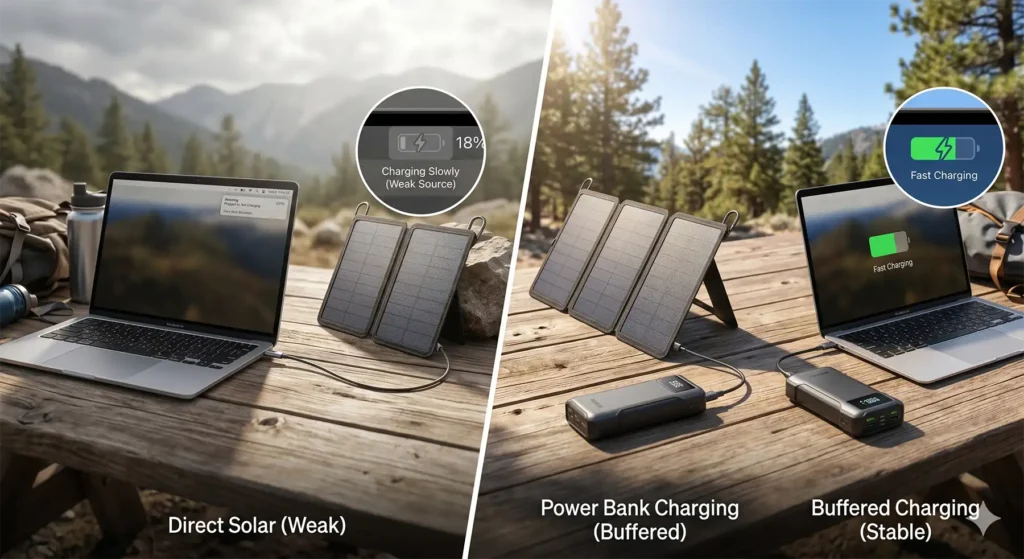
We highly recommend never charging your phone directly from a solar panel. Fluctuation in solar current can cause your phone’s charging circuit to heat up and degrade. Instead, charge a lightweight 10,000mAh or 20,000mAh power bank from the solar panel, and then use that power bank to charge your phone. This protects your phone’s battery and captures every drop of solar energy.
Frequently Asked Questions (FAQs)
Q1: Can I charge my solar panel through a tent window or car windshield?
Yes, but efficiency drops by 50% to 70%. Modern window glass is treated with UV-blocking filters. Since solar cells rely heavily on UV and direct light spectrums, passing through glass severely throttles their output. Always place your panel in direct, unobstructed sunlight.
Q2: Do solar panels work on cloudy days?
Yes, but with significantly reduced output. A high-quality monocrystalline solar panel will still generate about 10% to 20% of its rated power under heavy cloud cover. However, a cheap polycrystalline panel will drop to near-zero output.
Q3: Is it safe to leave a solar panel in direct hot sun?
Yes, the panels are designed for it, but your devices are not. Solar cells actually lose efficiency as they get extremely hot. Keep your phone, power bank, and cables shaded directly underneath or behind the solar panel to prevent thermal shut-offs or battery degradation.