
- Powerful yet Compact: Boasting a 1,500W AC output and a 3,000W surge peak, the Solar Generator 1000 V2 can power multiple appliances, including AC units, fridges, and electric pots. With a 1,070Wh cap…
- One Hour Fast Charging: Charge your Explorer 1000 v2 Portable Power Station from 0% to 100% battery level in just one hour with emergency charging activated via the Jackery App. It defaults to 1.7 hou…
- 10 Year Lifespan: The Explorer 1000 v2 portable power station is equipped with a durable LFP battery, maintaining over 70% of its original capacity even after 4,000 charge cycles, offering longevity e…
Can You Leave a Portable Power Station in a Hot Car?
(Affiliate Disclosure: Some of the links in this article are affiliate links. If you purchase through these links, Gadget Earth may earn a small commission at no extra cost to you. We only recommend sustainable gear, off-grid tech, and resources we rigorously evaluate. As an Amazon Associate, we earn from qualifying purchases.)
Summer road trips and van life adventures often mean leaving your vehicle parked at a trailhead for hours while you hike. If your off-grid setup includes a Jackery, EcoFlow, or Bluetti, your first instinct might be to leave it locked in the trunk or sitting on the passenger seat until you return.
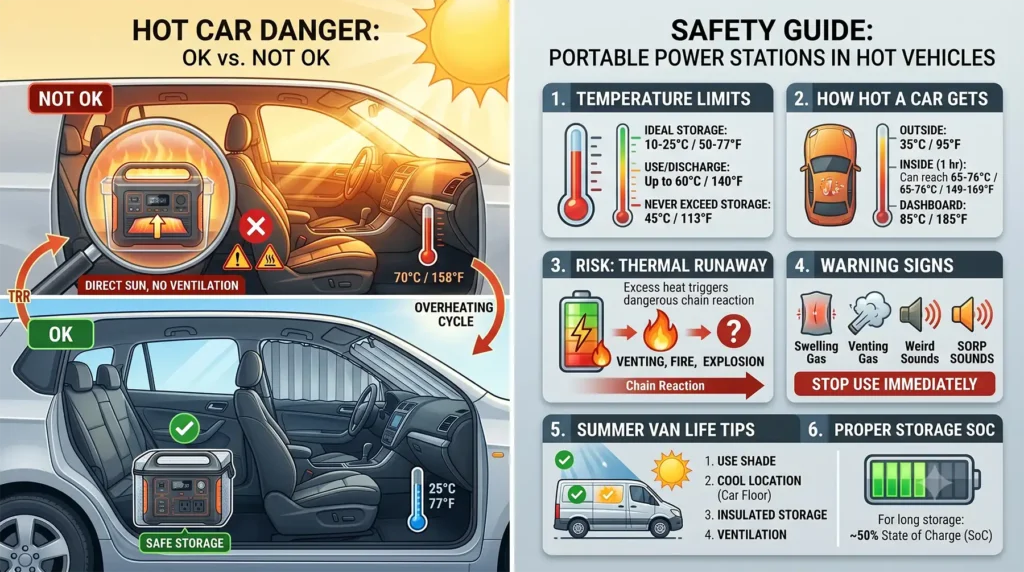
Can you leave a portable power station in a hot car? No, you should never leave a portable power station in a hot car during the summer. Portable power stations degrade rapidly when exposed to temperatures above 113°F (45°C). In direct summer sunlight, the interior of a closed vehicle can easily exceed 140°F (60°C), which can cause permanent battery capacity loss, swelling, or a catastrophic thermal runaway (fire).
While modern power stations have advanced safety chips, physics always wins. Here is exactly what heat does to your battery and how to safely store your gear during summer travel.
The Science: What Heat Does to Lithium Batteries
Portable power stations are essentially massive boxes of densely packed chemical energy. To function, they rely on a delicate internal balance.
When a lithium-based battery gets too hot, the internal liquid electrolytes begin to break down and generate excess gas.
- Stage 1 (Capacity Fade): At prolonged temperatures above 113°F (45°C), the battery’s internal chemistry permanently degrades. Even if it doesn’t break, a station left in a hot car will lose a significant chunk of its total lifespan, meaning a 500Wh battery might only hold 400Wh next year.
- Stage 2 (Swelling): As gases build up, the battery cells physically expand. If your power station’s plastic casing starts to bulge or warp, the battery is permanently destroyed and is an active fire hazard.
- Stage 3 (Thermal Runaway): If internal temperatures exceed 140°F to 160°F (which happens quickly in a car parked on asphalt), the battery can enter thermal runaway. The heat causes a short circuit, creating more heat, which eventually ignites the lithium into a self-sustaining, explosive chemical fire.

- Easy Installation & Quick Upgrade: Revolutionize your golf cart! This 48V lithium battery directly replaces 6-8V 100Ah heavy lead-acid batteries in one simple and wiring-free installation. Enjoy 74% w…
- Safer Metal Case & Metal Fixtures: 48V golf cart lithium battery features a sturdy, fireproof, anti-collision sheet metal case, with a vent and one-key safety switch (reduces power consumption). Its s…
- Power Performance & Wide Compatibility: 48V 100Ah LiFePO4 lithium battery, designed specifically for golf carts, features a 200A BMS, 2C discharge capacity (250A/30S) and peak current(700A/1s). It del…
LiFePO4 vs. Standard Lithium-Ion in the Heat
You might be wondering if the newer battery chemistry—LiFePO4 (Lithium Iron Phosphate)—makes a difference.
Yes, LiFePO4 (found in newer EcoFlow River 2s, Bluetti models, and Anker Solix units) is vastly superior to older Lithium-ion (NMC) batteries when it comes to thermal stability. A LiFePO4 battery has a much higher threshold before it catches fire.
However, thermal stability does not mean heat immunity. While a LiFePO4 station is far less likely to burn your car down, baking it in a 130°F trunk will still permanently destroy its charge capacity and void your manufacturer warranty.
How to Safely Store Your Power Station During Summer Travel
If you have no choice but to leave your power station in a vehicle while you hike or run errands, you must actively manage the ambient temperature.
- Keep it Low (The Floorboard Rule): Heat rises. The dashboard, seats, and trunk deck are the hottest parts of a car. Place your power station flat on the floorboards, preferably tucked under a seat where it is entirely out of direct UV sunlight.
- Crack the Windows: Stagnant air acts as an oven. Leaving your windows cracked just one or two inches allows the superheated air to escape, significantly lowering the peak temperature inside the cabin.
- Use a Reflective Sunshade: Blocking the greenhouse effect at the windshield is the fastest way to drop the internal temperature of the car.
- Do Not Charge It: Never leave a power station plugged into a solar panel or a 12V car charger while unattended in a hot vehicle. Charging generates internal heat. Adding internal charging heat to external summer heat is a recipe for disaster.
The Gadget Earth Verdict
Your portable power station is one of the most expensive and critical pieces of off-grid gear you own. Treat it like a cooler full of fresh groceries. If it is too hot for you or a pet to sit comfortably in a parked car, it is too hot for your lithium battery. When in doubt, bring it inside with you, or park in deep shade to protect your investment.