
- 🔋Double the Capacity, JUST 35% HEAVIER: With twice the capacity of standard power banks, this 20,000mAh portable charger with built-in cords powers an iPhone 16 up to 3 times, Galaxy S24 up to 2.9 tim…
- Built-in 4 Cables: Includes 3 output cables and 1 input cable, letting you charge almost all devices—iPhone, iPad, Galaxy, other USB-C phones, tablets, and Micro devices—without carrying extra cords o…
- Charge 6 Devices at Once: This portable chargers for multiple devices features 6 outputs (3 built-in cables + 3 external ports) and 4 inputs (2 built-in cables + 2 external ports), allowing you to cha…
TSA Rules for Power Banks 2026: Can You Fly With Your Portable Charger?
(Affiliate Disclosure: Some of the links in this article are affiliate links. If you purchase through these links, Gadget Earth may earn a small commission at no extra cost to you. We only recommend sustainable gear, off-grid tech, and resources we rigorously evaluate. As an Amazon Associate, we earn from qualifying purchases.)
When packing for a flight, your portable power bank is likely the first piece of tech you toss into your backpack. Whether you are traveling for a quick weekend conference or an extended off-grid adventure, staying charged at the airport is essential. However, because power banks are essentially giant blocks of volatile lithium-ion chemistry, aviation authorities heavily regulate them.
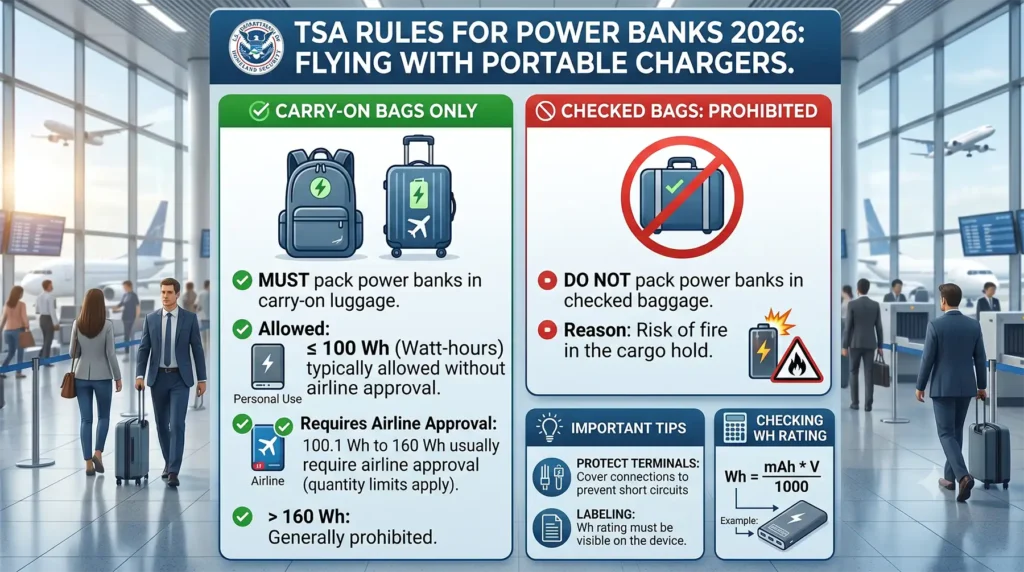
What are the TSA rules for power banks in 2026? Under current TSA guidelines, you can bring power banks on a plane, but they must be packed in your carry-on bag, never in checked luggage. The capacity of the power bank must be 100 Watt-hours (Wh) or less. You can bring up to two larger power banks (between 101Wh and 160Wh) only with explicit airline approval.
If you are packing a heavy-duty laptop power bank or a massive portable power station, here is exactly how to calculate your capacity and get through airport security without your expensive gear getting confiscated.
The Golden Rule: Carry-On Bags Only
This is the most critical rule, and the one that causes the most confiscations at the airport.
Never, under any circumstances, pack a power bank or any spare lithium-ion battery in your checked luggage that goes under the plane.
Why? In the pressurized, inaccessible cargo hold, a damaged or defective lithium battery can experience a “thermal runaway”—a self-sustaining chemical fire that is incredibly difficult to extinguish. In the passenger cabin, flight attendants have specialized fire-retardant bags and extinguishers to quickly handle a smoking battery.
If TSA scanners detect a power bank in your checked suitcase, they will physically open your bag, remove the battery, and leave a printed notice inside. You will not get the power bank back.
The Watt-Hour Limits (Doing the Math)
The FAA and TSA do not measure battery limits in “mAh” (milliamp-hours), which is how most manufacturers label their products. They measure capacity in Watt-hours (Wh).
If your power bank does not have the Watt-hour capacity clearly printed on its casing, TSA agents reserve the right to confiscate it. Fortunately, the math to convert mAh to Wh is very simple:
(mAh x Volts) / 1000 = Watt-hours (Note: Most USB power banks operate at a nominal 3.7V)

- 87W Power to Share: Distribute 87W across three devices, with a single device receiving up to 65W, to rapidly charge iPhones, Samsung phones. Quickly charge a 14″ MacBook Pro to 50% in under 40 minute…
- Speedy Cable Charging: Utilize the built-in cable to elevate your iPhone 15 Pro to 58% or a MacBook Air to 52% in 30 minutes. You can also fully recharge this power bank in 1.5 hours with a 65W charge…
- 20,000mAh for Extended Use: Eliminate concerns about battery depletion with a 20,000mAh power bank that ensures consistent, reliable charging for all your devices, also approved for airline travel.
Category 1: Under 100Wh (The Safe Zone)
This covers 95% of consumer power banks. You can bring as many of these as you want for personal use, provided they fit in your carry-on.
- The Limit: Up to 100Wh (roughly 27,000mAh).
- Examples: Anker PowerCore 10,000mAh, Goal Zero Flip 12, BLAVOR Solar Power Bank.

- [Beyond a Power Bank] – More than a power bank, Elite 10 is a 128Wh portable power station with a 200W AC outlet, 100W USB-C fast charging, and multiple DC ports. Equivalent to 4 regular power banks, …
- [Lightweight & Airline-Friendly] – Just 4.0 lbs with an ergonomic handle, this palm-sized portable power station slips easily into your backpack. With a 128Wh capacity, it falls within the 100–160Wh r…
- [Reliable UPS Backup] – This 128Wh portable power station features a built-in 10ms UPS and 350W bypass output to instantly keep laptops, Wi-Fi routers, security cameras, and gaming setups running duri…
Category 2: 101Wh to 160Wh (Needs Airline Approval)
If you are carrying a massive power bank designed to charge large laptops or drones, it likely falls into this category.
- The Limit: 101Wh to 160Wh (roughly 27,000mAh to 43,000mAh).
- The Rule: You are legally allowed to bring a maximum of two spare batteries in this size range per passenger. However, the TSA explicitly states this requires airline approval. You must notify the gate agent or the check-in desk before boarding.

- 【170W Total Output for High-Power Devices】 This 170W fast charging power bank delivers enough power to charge laptops, tablets, and smartphones simultaneously. With 100W single-port output, it works a…
- 【Massive 25000mAh High-Capacity Battery】 Featuring premium automotive-grade cells, this 25000 mAh power bank delivers long-lasting and stable power. It can charge a MacBook Pro up to 1 time, a MacBook…
- 【80 Minutes-Fast Recharge】 Thanks to 100W fast input, this fast charging power bank can fully recharge in as little as 80 minutes. That’s up to 50% faster than standard high-capacity power banks, maki…
Category 3: Over 160Wh (Strictly Prohibited)
If you are an off-grid traveler bringing a portable power station (like a Jackery Explorer 300 or EcoFlow River 2), you are out of luck.
- The Rule: Any battery exceeding 160Wh is banned from all passenger flights, both in carry-on and checked luggage. They must be shipped ahead of your trip via specialized ground or sea freight.
Best Practices for Flying with Power Banks
- Protect the Terminals: The TSA requires that you prevent your power banks from short-circuiting. Ensure no loose coins or keys can get stuck inside the USB ports. Keep the power bank in its original retail packaging, a dedicated tech pouch, or simply put a piece of electrical tape over the ports.
- Check for Swelling: If your power bank looks slightly puffy or the casing is splitting open (the dreaded “spicy pillow”), do not bring it to the airport. It is an active fire hazard and will be confiscated immediately.
- Read the Print: Over time, the printed specifications on the back of a power bank can rub off. If the TSA agent cannot read the capacity, they may seize it out of an abundance of caution. Consider placing a piece of clear tape over the text when you buy a new charger to preserve the ink.
The Gadget Earth Verdict
Air travel with off-grid tech doesn’t have to be stressful. Stick to a high-quality 20,000mAh (roughly 74Wh) power bank with clear manufacturer labels. It will easily pass through TSA checkpoints without a second glance, providing more than enough power to keep your phone, headphones, and tablet fully charged from takeoff to touchdown.