Table of Contents
I. Introduction: The Evolution of Off-Grid Work
Off-grid work in 2026 is no longer just about hoarding battery power or frantically searching for a single bar of cellular signal on a mountaintop. In fact, if your entire remote work setup relies merely on finding a decent café with Wi-Fi, you might be falling behind. Today, the digital nomad lifestyle has undergone a fundamental transformation. We have entered an era where digital resilience, privacy, and true sovereignty over your data and connectivity are the hallmarks of a successful remote professional. It’s no longer about whether you can connect to the internet, but rather how much of your crucial work you can accomplish when the internet decides to vanish.
The evolution of off-grid work has been swift and unforgiving. Just a few years ago, the focus was entirely on cloud-dependent workflows. Everything from your daily notes to your high-level project management boards lived exclusively in the cloud. We assumed that ubiquitous connectivity was a solved problem. But as any seasoned digital nomad will attest, unpredictable satellite drops, unexpected cellular dead zones, and the inherent fragility of constant cloud syncing have proven that 100% reliance on a persistent connection is a glaring vulnerability.
This realization has catalyzed a massive paradigm shift away from cloud-dependent workflows toward “Offline-First” systems. This philosophy fundamentally flips the script: instead of treating the internet as a requirement for your tools to function, the internet is treated merely as a luxury—a conduit for syncing when it’s available, rather than a prerequisite for productivity.
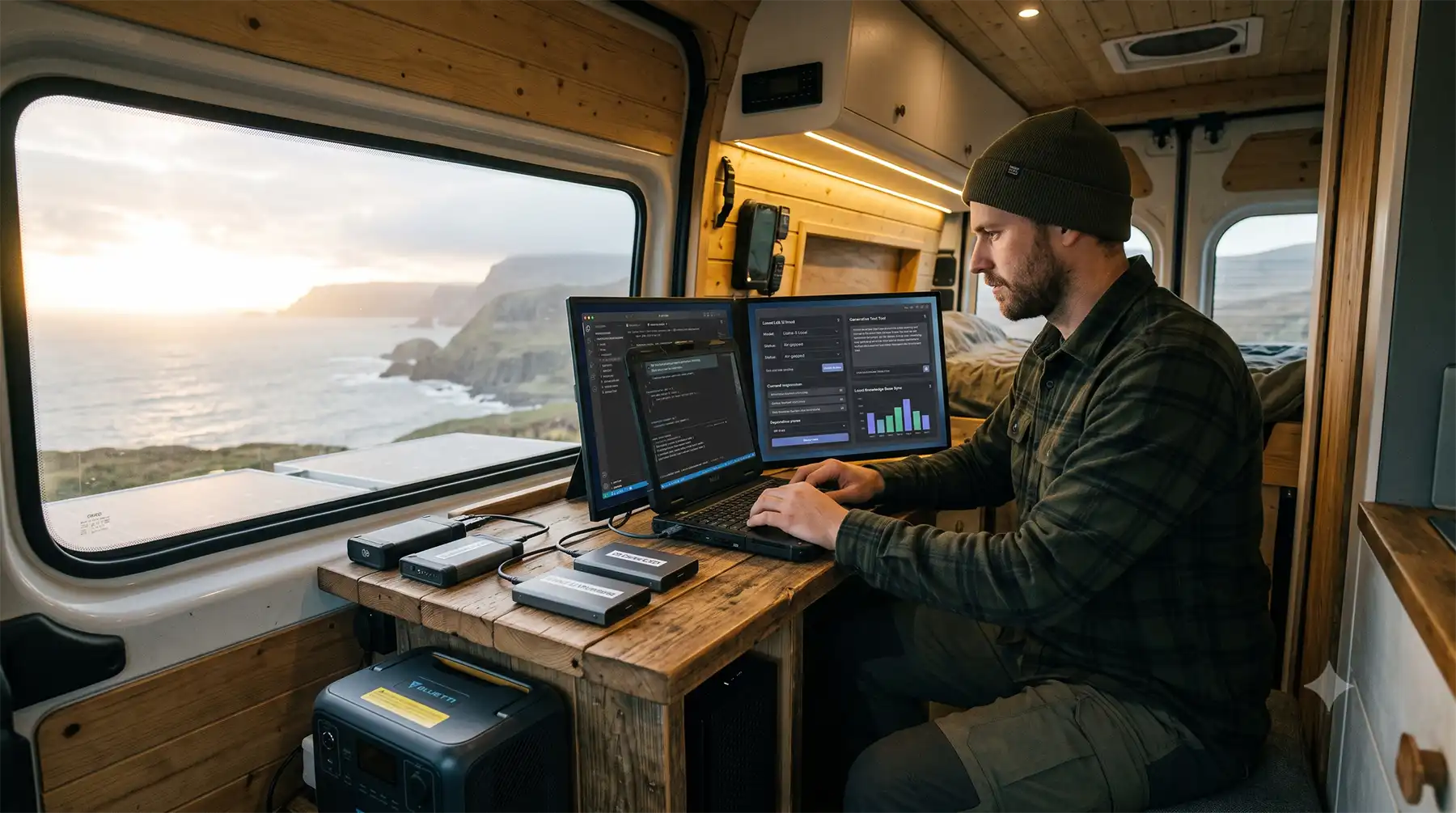
In this comprehensive guide, we will explore the cutting-edge tech trends of 2026 that empower the modern, off-grid professional. From the rise of the offline-first workspace and the integration of powerful local Artificial Intelligence, to the marvels of hybrid bonded connectivity and next-generation off-grid power setups, we are going to dive deep into what it takes to build a truly resilient, unplugged, and unstoppable mobile workspace. Whether you are living in a customized sprinter van, sailing across the ocean, or simply want a foolproof setup for extreme remote work, understanding these 2026 tech trends will safeguard your productivity against any disruption.
Affiliate Disclosure: Some of the links in this article are affiliate links. If you purchase through these links, Gadget Earth may earn a small commission at no extra cost to you. We only recommend sustainable gear, off-grid tech, and resources we rigorously evaluate. As an Amazon Associate, we earn from qualifying purchases.

- 【Modular & Scalable System】Easily configure secure single, dual, or triple-person office desk workstations using interlocking panels and reinforced frames, adapting perfectly to growing teams or chang…
- 【Sturdy Executive Desk Options】Features robust desk configurations secured with fixed screws for exceptional stability, preventing wobble or shifting, ideal for focused work or collaborative corners.
- 【Integrated Power Hub Desk】Includes a versatile multi-functional cable management box (not a drawer unit) featuring 2 AC outlets + USB ports, keeping devices charged and cords organized within your mo…
II. What is the “Offline-First” Workspace?
To fully grasp the “Offline-First” philosophy, we have to unlearn a decade of software habits. An offline-first workspace is built on tools and systems designed to function at 100% capacity without an internet connection. When connectivity returns—whether through a passing cellular tower or a stabilized satellite link—these tools sync seamlessly in the background without interrupting your flow state.
The Offline-First Philosophy
The core tenet of offline-first digital nomad tools in 2026 is uncompromising reliability. Think about a traditional web app: if your connection drops, the app typically freezes, throws an error message, and blocks you from accessing your own data. This is catastrophic when you are out in the wilderness with looming client deadlines. Conversely, an offline-first tool assumes you are disconnected by default. Your data lives on your local hard drive first. It is accessible instantly, searches are lightning-fast, and interactions are zero-latency. You own the data, you control the access, and the cloud acts only as a backup repository or a collaboration channel, rather than a gatekeeper to your work.
The Tech Stack: Ditching Bloatware
In 2026, the tech stack for digital nomads has significantly diverged from mainstream corporate SaaS bloatware. Remote professionals are moving away from heavy web-based applications that demand continuous pinging to a server. Instead, there is a renaissance of resilient, local-first tools.
Take knowledge management, for example. Obsidian continues to dominate this space because it operates entirely on local Markdown files. Your entire database of thoughts, notes, and research is stored directly on your drive. There is no waiting for a server to load your notes. Local project boards like Linear (with its aggressive offline capabilities) or completely localized Kanban applications have replaced purely web-based alternatives. These tools empower you to organize tasks, write code, edit video, and manage clients without a single byte of data leaving your machine until you are ready.
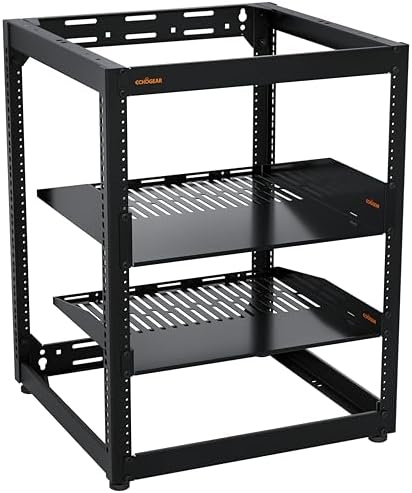
- Includes all the goodies you need to rack ’em up: Entire 15U open frame rack structure, 4x leveling feet, 1x 1U vented shelf (15.12″ deep), 1x 2U vented shelf (18″ deep), and 25x rack mounting screws….
- Open design and included vented shelves optimize air flow, keeping even today’s hottest, high-end networking and AV components cool.
- Assembly is required, but it’s simple. With all the included hardware & witty instructions, you’ll have your rack ready for servers & networking gear in under 20 minutes.
Portable Servers: The Digital Survival Kit
Perhaps the most fascinating development in the offline-first movement is the rise of the portable server. We are seeing digital nomads carry what are effectively “digital survival kits”—miniature, ruggedized servers powered by systems like Project NOMAD or refugiOS.
These aren’t bulky enterprise servers; they are highly efficient, Raspberry Pi-sized micro-computers or even partitioned environments on powerful modern laptops that act as a personal cloud. They host massive databases entirely offline. Imagine having a complete, searchable copy of Wikipedia, detailed topographical offline maps, massive repositories of coding documentation, and gigabytes of reference material available instantly without an internet connection.
By turning their local environment into a self-contained server, off-grid workers can conduct deep research, reference obscure technical manuals, and navigate complex geographical data even when they are completely cut off from the global network. It is the ultimate expression of digital sovereignty, ensuring that your capability to produce high-value work is never tethered to the availability of a signal.
III. Local AI: The 2026 Killer Feature
If you were to point to a single defining technological leap for remote work in 2026, it would undeniably be the integration of Local AI. While the early 2020s were characterized by cloud-based Large Language Models (LLMs) that required constant, high-bandwidth connections, the landscape has dramatically shifted toward running AI entirely on your local machine.
Privacy and Sovereignty through Zero Telemetry Software
One of the most pressing concerns for remote professionals—especially those handling sensitive information like therapists, lawyers, financial advisors, and researchers—is data privacy. Cloud-based AI systems are notorious for their telemetry; they ingest prompts, analyze interactions, and often use user data to train future models. For professionals bound by strict confidentiality agreements or ethical obligations, sending client data to a third-party cloud server is simply a non-starter.
This is where zero telemetry software for digital nomads and local LLMs come into play. By running models locally using software like LM Studio or Ollama, professionals can leverage the incredible reasoning and generative capabilities of AI without a single packet of data leaving their device. You can summarize confidential legal briefs, analyze sensitive financial datasets, or transcribe deeply personal therapeutic notes with absolute certainty that your data remains entirely private. This local-first AI movement has democratized access to advanced machine learning, ensuring that privacy and AI assistance are no longer mutually exclusive.
NPU-Powered Productivity and Energy Efficiency
The question has always been: how do you run computationally intensive AI models on a laptop without instantly draining your off-grid power station? The answer lies in the hardware revolution of Neural Processing Units (NPUs).
In 2026, standard professional laptops are equipped with highly advanced NPUs explicitly designed to handle matrix multiplication and AI workloads at a fraction of the power cost of traditional GPUs. These chips allow for fast, battery-efficient AI processing. You can run a sophisticated 14-billion parameter model on your laptop to draft emails, write code, or analyze data without spinning up massive cooling fans or obliterating your battery life. For the digital nomad living on solar power, this energy efficiency is game-changing. It means you can have a world-class AI assistant helping you write a 2,500-word blog post or debug complex software architecture, all while consuming minimal wattage from your portable power bank.
Semantic Search: A Google for Your Own Brain
Running AI locally isn’t just about chatting with a bot; it’s about fundamentally changing how you interact with your own data. One of the most powerful applications of local AI is semantic search across personal files.
Imagine having thousands of PDFs, research papers, journal entries, and client notes spanning a decade of work. Traditional keyword search is often clunky and imprecise. Local AI enables semantic search, meaning you can search your local drive by concept rather than exact keywords. You can ask your computer, “What did I write about the psychological impacts of remote work back in 2024?” and the local AI will instantly scan, synthesize, and retrieve the exact documents and paragraphs relevant to your query, even if the exact keywords were never used. It is like having a private Google search engine for your own brain, functioning perfectly deep in a forest with zero internet connection.

- Hybrid Communication: On-Grid + Off-Grid in One System: Use the Spectre Pro as a full Android phone with SIM or WiFi, and switch to LoRa MeshCore communication when networks are unavailable. The Mini …
- Advanced Mesh Networking with MeshCore: Built for users who want more control, this bundle supports MeshCore-based communication, enabling flexible and customizable off-grid networking.
- Stay Connected Without Cell or Internet: When traditional networks fail, both devices use LoRa mesh communication to send messages and share data across long distances.
To secure your connection and run hardware-level VPN encryption across all of your local devices, deploying a physical travel router is a non-negotiable shield. Explore our complete hand-picked reviews of the best travel routers for remote workers to protect your data before it even hits hotel networks.
IV. Hybrid Connectivity: The “Always-On” Insurance Policy
While the offline-first philosophy is essential for uninterrupted deep work, the reality of the modern digital economy is that you eventually have to connect. You must jump on client Zoom calls, push code to remote repositories, and submit deliverables. When it’s time to connect, you cannot afford dropped packets or lagging audio. This is where hybrid connectivity solutions come in.

- Ultra-Compact Design: Lightweight and portable for easy transport and quick setup—ideal for boats, RVs, campers, and off-grid cabins.
- Global Coverage: Connect from virtually any location on land or sea through SpaceX’s expansive satellite constellation.
- High-Speed, Low-Latency Internet: Stream, game, and work remotely with speeds comparable to home broadband.
Beyond Basic Starlink
A few years ago, installing a Starlink dish on the roof of a campervan was the ultimate flex for a digital nomad. It promised high-speed internet anywhere in the world. However, veteran off-grid workers quickly learned that Low Earth Orbit (LEO) satellite internet is not infallible. A heavily forested campsite, a passing severe thunderstorm, or a slight repositioning of your vehicle could lead to frustrating micro-drops in connectivity. When you are presenting a high-stakes pitch to a Fortune 500 client, a 10-second drop can kill your momentum and professionalism.
The modern nomad in 2026 has moved beyond relying on a single point of failure. The new standard is the bonded hybrid connection.
How Bonded Hybrid Connectivity Works
Bonded hybrid connectivity is the process of merging multiple discrete internet connections into a single, unshakeable pipeline. Today’s off-grid workers use advanced software-defined edge platforms—often integrated directly into mobile routers—to combine their Starlink satellite connection with multi-network 5G eSIMs.
Here is how it practically functions: you set up your Starlink dish to establish your primary, high-bandwidth LEO connection. Simultaneously, your mobile router connects to the two strongest cellular towers in your area using global 5G eSIM technology. The software-defined edge platform takes all of your outgoing and incoming traffic—whether it’s a video call, a file upload, or a secure VPN connection—and intelligently splits the data packets across all active connections.
Seamless Failover: Never Drop a Frame
The true magic of Starlink and bonded cellular hybrid connectivity is its seamless failover capability at the packet level. Imagine you are leading a crucial video conference. You are parked near a treeline. Suddenly, the wind blows a large tree branch directly into the line of sight of your satellite dish, obstructing the signal.
In a traditional setup, your call would freeze, and you would scramble to apologize as you try to reconnect. But with a bonded hybrid system, the software instantly detects the packet loss on the satellite link and immediately routes the remaining audio and video packets through your active 5G cellular connection. This transition happens in milliseconds. To your clients on the other end of the screen, there is absolutely no interruption. You don’t drop a single frame or miss a single syllable. This “always-on” insurance policy is what allows modern remote professionals to operate from the absolute edge of civilization with the reliability of a fiber-optic corporate office.

V. Next-Gen Off-Grid Power Innovations
None of the technology we have discussed—portable servers, local AI processing, or multi-WAN routers—is possible without a robust, intelligent, and highly efficient off-grid power system. In 2026, the era of loud, gas-guzzling generators and incredibly heavy lead-acid batteries is long gone. The power systems of today are silent, smart, and astonishingly efficient.

- ★【High Efficiency】 : SUNGOLDPOWER UL61730 CEC Listed N-Type 16BB 590W Bifacial monocrystalline solar panel can generate more energy up to 22.8%. Bifacial technology allows for the harvesting of up to …
- ★【High Tolerance】: SUNGOLDPOWER 590W N-Type Bifacial Dual Glass Module offer higher durability even rough climatic heat /cold/snow/wind.
- ★【Widely Use】: SUNGOLDPOWER 590 watt Bifacial solar panels can be set up at any angle. No need to analyse or calculate the right mounting and tilt angle. Embrace a variety of installation methods and …
Bifacial and Flexible Solar Panels
Solar technology has seen incremental but vital improvements, particularly in the realm of mobile deployments. The biggest trend for van lifers, RVers, and off-grid cabins is the mass adoption of bifacial solar panels.
Traditional solar panels only capture sunlight from the top surface facing the sky. Bifacial solar panels for van life, however, are designed with a transparent backsheet and photovoltaic cells that can capture light from both sides. When mounted on the roof of a van or deployed on the ground, these panels not only absorb direct sunlight but also capture the ambient light reflecting off the roof of the vehicle, the snow, the sand, or the water below.
This dual-sided capture can increase energy yield by up to 30% without taking up any additional square footage on a crowded vehicle roof. Paired with new, ultra-durable flexible thin-film solar technology that can conform to the aerodynamic curves of modern vehicles, nomads are generating more power per square inch than ever before.

- SMART SOLAR CHARGE CONTROLLER: Solar charge the smart way with the Victron Energy SmartSolar MPPT charge controller, to ensure that every ray of available sunlight is converted into usable energy, whi…
- MAXIMIZE POWER OUTPUT: With lightning-fast optimum power point tracking and intelligent charge algorithms the Victron MPPT solar charge controller makes sure you always get the maximum possible power …
- SYNCHRONIZED CHARGING: Multiple SmartSolar MPPT charge controllers can synchronize to behave as one, simultaneously switching through different charge stages to ensure battery longevity and system wid…
Smart Energy Management and MPPT Controllers
Generating power is only half the battle; managing it efficiently is where the real wizardry happens. The latest generation of Maximum Power Point Tracking (MPPT) charge controllers are essentially smart computers dedicated to optimizing energy flow.
In 2026, these controllers are often cloud-synced (when connected) to download highly localized, micro-weather forecasts. If the system knows a massive, multi-day storm front is approaching, it will automatically optimize the charging algorithms and alert the user to restrict non-essential power draw. During heavily overcast days, these smart MPPT controllers use advanced algorithms to sweep the voltage curve, squeezing every possible milliamp of efficiency out of the scattered light hitting the panels.

- Powerful yet Compact: Boasting a 1,500W AC output and a 3,000W surge peak, the Solar Generator 1000 V2 can power multiple appliances, including AC units, fridges, and electric pots. With a 1,070Wh cap…
- One Hour Fast Charging: Charge your Explorer 1000 v2 Portable Power Station from 0% to 100% battery level in just one hour with emergency charging activated via the Jackery App. It defaults to 1.7 hou…
- 10 Year Lifespan: The Explorer 1000 v2 portable power station is equipped with a durable LFP battery, maintaining over 70% of its original capacity even after 4,000 charge cycles, offering longevity e…
Portable LiFePO4 Systems: The Heart of the Workspace
Supporting this entire ecosystem are Lithium Iron Phosphate (LiFePO4) battery systems. While not entirely new in 2026, the density, safety, and integration of these systems have reached maturity. We are seeing portable power stations that are lighter, can withstand thousands upon thousands of deep charge cycles, and feature integrated pure sine wave inverters capable of running massive computational loads safely.
These modern LiFePO4 systems integrate flawlessly with the smart MPPT controllers and provide the deep, stable energy reserves required to run NPU-powered laptops, bonded cellular routers, and local servers through long winter nights or days of relentless rain. They are the silent, beating heart of the sovereign digital nomad’s workspace.
VI. Conclusion: The Sovereign Digital Nomad
As we navigate through 2026, the definition of off-grid work has transcended mere geography; it has become a philosophy of technological independence. The fragile, cloud-dependent workflows of the past have been largely replaced by robust, offline-first architectures.
The sovereign digital nomad of today is a professional who refuses to let their productivity be dictated by the presence of a cell tower. By leveraging portable servers and zero telemetry software, they own their data completely. Through the incredible power of local AI and NPU efficiency, they have supercomputer-level assistance at their fingertips without sacrificing privacy or battery life. And when they do choose to connect with the world, they rely on the unbreakable redundancy of Starlink and bonded cellular hybrid connectivity. All of this is sustainably fueled by the latest advancements in bifacial solar panels and smart LiFePO4 energy management.
This isn’t just about working from a beautiful beach or a remote mountain pass. It is about building a professional life that is resilient, private, and truly yours.
Join the Conversation Are you currently building your own unplugged workspace? We want to hear from you. Which “offline-first” tool has become indispensable to your daily workflow? Have you taken the leap and tried running a Large Language Model locally on your current machine? Drop your experiences, questions, and tech stack details in the comments below!