For a long time, building an off-grid solar setup felt like a game of managing scarcity. You’d bolt a massive, heavy glass panel to the roof of your van or cabin, cross your fingers for blue skies, and ultimately accept that you were probably only going to see about 20% efficiency in the real world.
If you wanted more power, your only option was to buy more panels—which meant adding more weight and taking up more space.
But as we dive deeper into the off-grid solar system trends 2026 is bringing to the table, that old strategy is officially obsolete. The industry is breaking past traditional efficiency ceilings, and it’s doing so by rethinking the physical design of the solar panel itself.
If you want to maximize your energy yield this year, it’s time to look at bifacial modules and next-gen flexible arrays. Here is exactly how they work, and more importantly, how to install them to get the absolute most out of your setup.
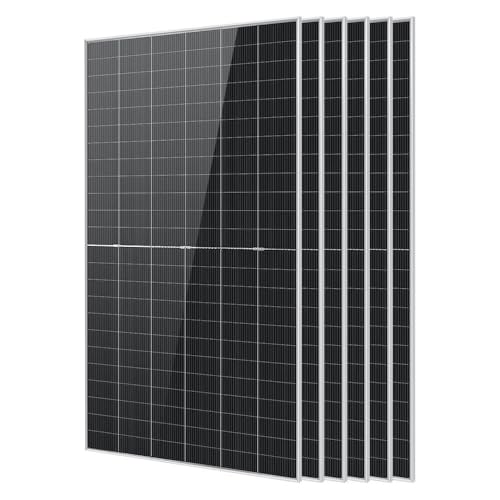
- ★【Lower Your Electric Bills】 : The SUNGOLDPOWER 590W bifacial solar panel uses advanced N-Type 16BB cells with up to 22.8% high efficiency, generating more power per square foot and helping you take c…
- ★【Up to 30% More Energy Output】 : The SGN-590-BDG1 solar panel is designed to capture sunlight from both the front and rear sides. This SUNGOLDPOWER solar panel bifacial model can generate up to 30% a…
- ★【Versatile & Installation-Friendly】Sungold solar panels designed for rooftop or ground-mounted systems, this high-efficiency 590W bifacial solar panel offers flexible installation options to fit diff…
Bifacial Solar Explained: Harnessing the “Albedo Effect”
Traditional solar panels have a single job: capture sunlight hitting the front of the panel. The back of the panel is usually just a solid, opaque backsheet doing absolutely nothing.
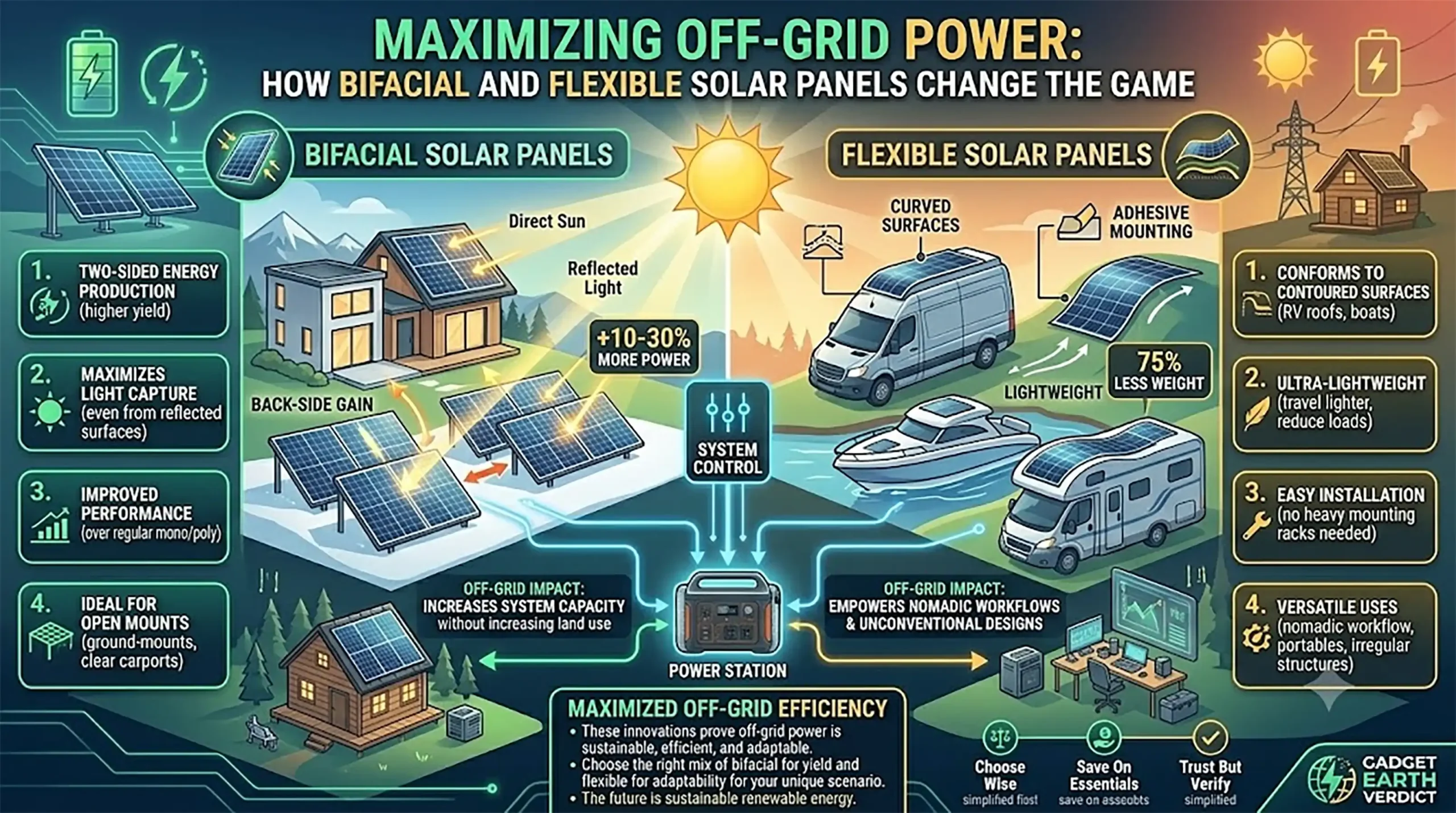
Bifacial solar panels change the equation entirely by featuring solar cells on both the front and the back. While the front absorbs direct sunlight, the back absorbs the light that hits the ground and bounces back up.
This reflected light is known in the physics world as the Albedo Effect.
Why should you care about the Albedo Effect? Because a properly mounted bifacial panel can increase your total energy yield by up to 30% compared to a traditional panel of the exact same size. You are essentially getting free, bonus electricity without giving up any extra real estate on your roof or lawn.
Installation Tactics: How to Actually Get That 30% Boost
Here is the catch: if you buy a bifacial panel and bolt it flat against your RV roof, the back side gets zero light, and you’ve wasted your money. To unlock that 30% yield increase, you have to optimize your environment.
Here is the DIY playbook for maximizing albedo effect solar collection:
- Elevate and Tilt: Bifacial panels need clearance underneath to allow light to bounce. Mount them on adjustable tilt brackets so you can angle them toward the sun while leaving a wide gap behind them.
- Optimize Your Surface: The lighter and more reflective the surface beneath the panel, the higher your energy yield.
- For RVs & Vans: Coat your roof with a brilliant white elastomeric or TPO roof coating. It lowers your interior temperatures while drastically boosting your solar reflection.
- For Ground Mounts: Avoid placing panels over dark dirt or asphalt. Crushed white gravel, light-colored concrete, or even snow-covered ground are incredible reflectors that will send your energy capture through the roof.
Flexible & Thin-Film Tech: Power Without the Payload
While bifacial panels are amazing for high-yield stationary or tilt-mount setups, they still rely on rigid frames. But what if you are trying to power an Airstream, a curved boat deck, or a lightweight teardrop trailer?
Enter the 2026 generation of flexible solar panels for RV and overland use.
Five years ago, cheap flexible panels were notorious for delaminating, overheating, and failing after a single rough summer. Today’s thin-film technology utilizes advanced ETFE coatings that are highly durable, self-cleaning, and heat-resistant.
The biggest advantage here is the weight. Modern flexible panels are up to 70% lighter than their rigid glass-and-aluminum counterparts. They can bend up to 250 degrees to conform to the aerodynamics of your rig, and you can mount them using industrial VHB tape—meaning absolutely no drilling holes into your expensive roof. We are even seeing these ultra-light modules integrated directly into canvas tents and hiking backpacks.
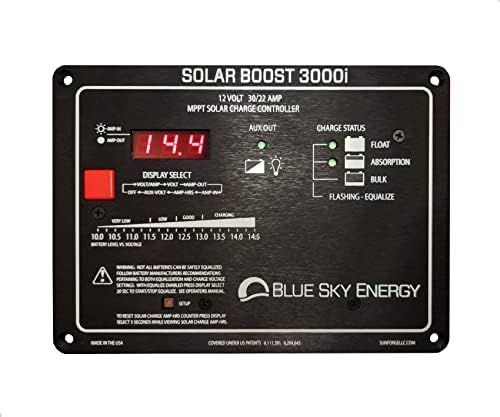
- MPPT solar charge controller for 12V-nominal battery (Pb or Li), charge current 30A with 36-cell panels max 400W or 22A with 60-cell panel max 290W. Max. recommended panel Voc at STC 40V (max voltage …
- Fully programmable multi-stage charge profile for Lead-Acid and Lithium batteries through the onboard display
- SB3000i with metal wall mount box and battery temperature sensor for Lead-Acid batteries
To get the most out of your high-efficiency bifacial solar panels, you need a system that tracks bi-directional flow in real-time. Check out our comprehensive guide to the best smart home energy monitors for solar tracking to see how to monitor your net-metering metrics step-by-step.
Cloud-Sync MPPT Controllers: Squeezing Out Every Last Drop
Generating power with cutting-edge panels is only half the battle; you still have to funnel that power into your batteries efficiently.
If you are upgrading your panels, you need a smart brain to run them. The latest plug-and-play solar kits are now shipping with AI-driven, cloud-syncing MPPT (Maximum Power Point Tracking) charge controllers.
These aren’t your grandfather’s charge controllers. Modern MPPTs actively adjust to the micro-fluctuations in light caused by passing clouds or shading from nearby trees. When your bifacial or flexible panels experience a sudden drop in voltage, a smart MPPT controller instantly recalculates the optimal electrical load, ensuring you pull the maximum possible wattage out of overcast, gloomy days.
While harvesting daytime solar is an exceptional off-grid baseline, severe winter storms or dark nights require a secondary backup. Read our newly published guide to the best portable wind turbines for camping to see how to build a resilient, 24/7 hybrid energy system.
The Bottom Line
Off-grid living is all about efficiency. You no longer have to cover every square inch of your rig with heavy glass to run your air conditioner or Starlink dish. By leveraging the reflected light of bifacial solar panels, or saving massive payload weight with durable flexible tech, you can build a 2026 off-grid setup that works smarter, not harder.